


Crabgrass in North Texas Lawns: Why It Keeps Coming Back and What Finally Stops It
Crabgrass in North Texas Lawns: Why It Keeps Coming Back and What Finally Stops It
If there is a weed that North Texas lawn care professionals encounter on more properties, more seasons, and with more homeowner frustration than crabgrass, it does not come to mind readily. Crabgrass is everywhere. It invades lawns that are otherwise well-maintained. It appears in the same spots year after year despite homeowners' attempts to pull it, spray it, and treat it. And it produces the kind of visible, spreading, light-green-against-dark-green contrast that makes even an otherwise attractive Bermuda or Zoysia lawn look neglected by midsummer.
The reason crabgrass is so persistent is not that it is particularly difficult to kill with the right product. It is that the life cycle of crabgrass — annual, seed-driven, germinating in early spring before most homeowners are thinking about weed management — creates a timing window that reactive management consistently misses. Crabgrass is fought almost universally at the wrong stage, which is why it keeps winning.
Understanding the specific biology of crabgrass in North Texas conditions, what correctly timed prevention looks like, and what options exist when prevention has already been missed transforms a frustrating annual defeat into a manageable, declining problem.
What Crabgrass Is and How It Works
Crabgrass (primarily large crabgrass, Digitaria sanguinalis, and smooth crabgrass, Digitaria ischaemum) is a warm-season annual grassy weed that completes its entire life cycle in a single growing season — germinating from seed in early spring, growing vigorously through summer, setting seed prolifically in late summer and early fall, dying with the first frost, and leaving behind a new generation of seeds to repeat the cycle the following spring.
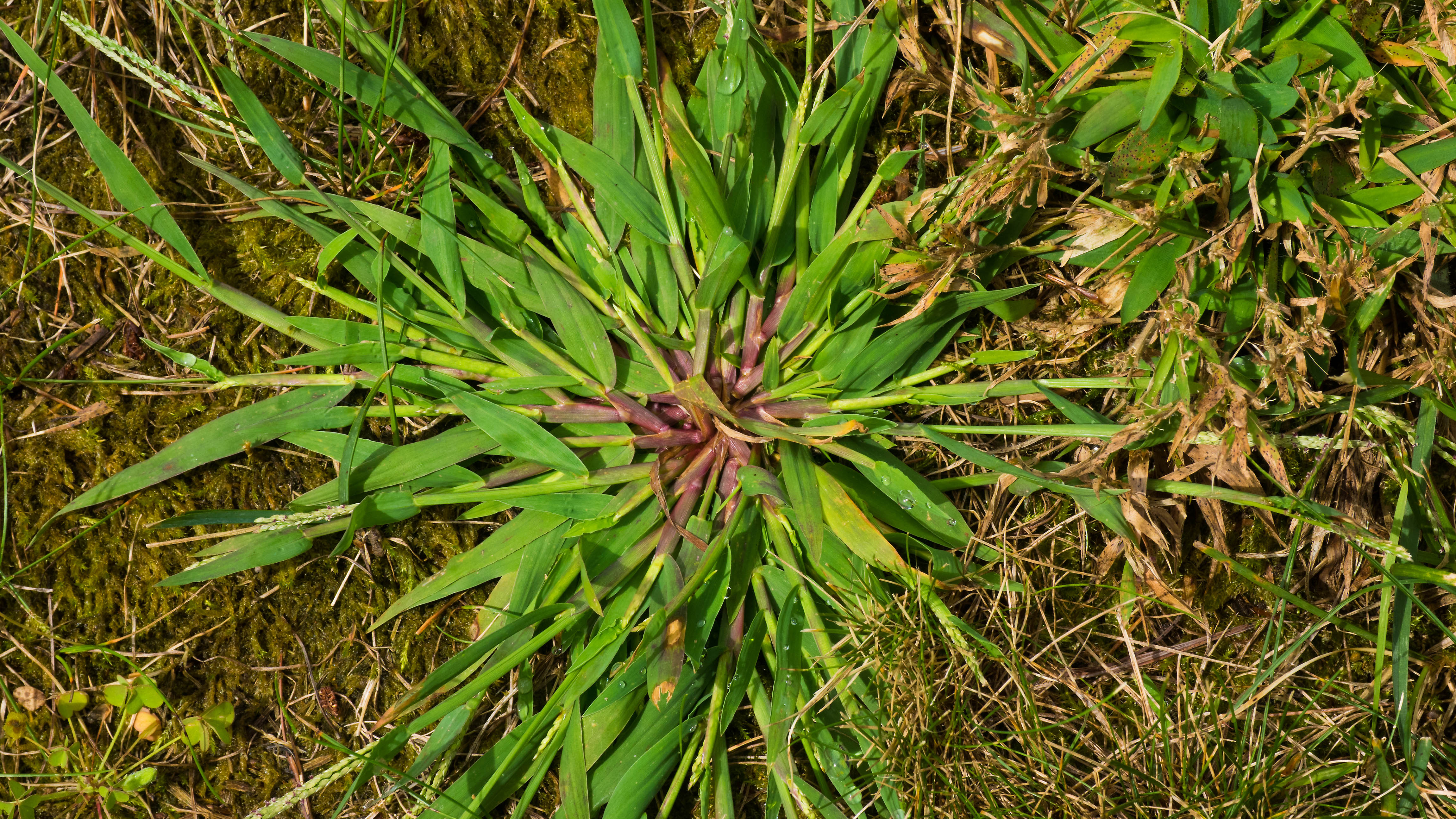
The visual characteristics that distinguish crabgrass from desirable turf are specific once you know what to look for. Crabgrass is a lighter, yellower green than Bermuda or Zoysia. Its blades are coarser and wider than Bermuda's fine blades. It grows in a low, spreading, star-burst or crab-shaped pattern from a central growing point — hence the name — with stems that radiate outward horizontally rather than growing upright. In Bermuda lawns, where the surrounding turf is finely textured and a consistent dark green, crabgrass patches are immediately visible as irregular, lighter-colored, coarse-textured intrusions.
The biological detail that determines whether crabgrass is manageable or overwhelming is the seed production scale. A single mature crabgrass plant produces between 150,000 and 700,000 seeds over the course of a single growing season. Those seeds are viable in the soil for three to five years. A lawn that has allowed crabgrass to set seed for several consecutive seasons has a seed bank in the soil that cannot be depleted in a single season of correct management — it requires several years of consistent prevention to deplete, because each year that prevention works also removes one year's seed production from the ongoing bank.
This is why crabgrass problems that have been allowed to develop over multiple unmanaged seasons take multiple correctly managed seasons to fully resolve. There is no single-season fix for a multi-year seed bank. There is only the patient, consistent prevention program that depletes the bank season by season.
Why Most Homeowners Fight Crabgrass at the Wrong Stage
The most common point at which homeowners notice crabgrass and take action is midsummer — July or August — when the crabgrass plants have reached visible size, are clearly competing with the surrounding turf, and are producing the unsightly contrast that motivates action.
This timing is wrong for two critical reasons.
First, crabgrass at this stage is a plant with an established root system, active growth, and — most critically — seed production already underway or imminent. Killing it at this point removes the visible plants but does not remove the seeds that are already forming or that have already dropped to the soil surface. The July homeowner who successfully kills their visible crabgrass with a post-emergent herbicide may believe they have solved the problem — but the seed bank for next spring has already been partially or fully restocked by the plants that had been growing since April.
Second, post-emergent crabgrass control in established warm-season lawns is more complicated than pre-emergent prevention. The most effective post-emergent products for mature crabgrass — those containing quinclorac — can damage or discolor St. Augustine and some Zoysia varieties if not applied carefully. Homeowners using generic post-emergent herbicides without understanding active ingredient compatibility with their specific grass type regularly damage their desirable turf while only partially controlling the crabgrass.
The correct crabgrass management is not reactive in July. It is preventive in late February or early March — before the germination window opens.
The Pre-Emergent Window: The Only Reliable Crabgrass Control Tool
Pre-emergent herbicide for crabgrass works by forming a chemical barrier at the soil surface that prevents crabgrass seeds from completing germination. Applied correctly before crabgrass seeds begin germinating, it stops the current season's generation before it ever becomes a visible problem. Applied after germination has begun — or not at all — it has no effect on the plants that are already growing.
The germination trigger for crabgrass in North Texas is soil temperature at the two-inch depth reaching 55 degrees Fahrenheit consistently for several days. In most North Texas years, this threshold arrives between late February and mid-March depending on the specific year's weather pattern. In early-warming years, it can arrive in mid-February. In late-spring years, it may not arrive until the third week of March.
This variability is exactly why calendar-date-based application is less reliable than soil-temperature-based application. A homeowner who applies pre-emergent on March 1 every year regardless of soil temperature may be correctly timed in some years and two to three weeks late in early-warming years — missing the window completely for that season's crabgrass prevention.
Professional lawn care operations that monitor soil temperature data specifically for the North Texas region apply pre-emergent within days of the germination threshold being reached — not on a fixed calendar date. This timing precision is one of the specific advantages of professional service over DIY management for crabgrass prevention.
Product selection for pre-emergent crabgrass control:
Prodiamine (sold under brand names including Barricade) and dithiopyr (sold as Dimension) are the two primary professional pre-emergent active ingredients for crabgrass control in North Texas warm-season turf. Both are safe for established Bermuda, St. Augustine, and Zoysia when applied at label rates. Dithiopyr has an additional advantage: it provides some post-emergent activity against very young crabgrass seedlings (before the three-leaf stage), giving it a slightly longer effective window than prodiamine if application timing is slightly delayed.
A single pre-emergent application at the correct timing typically provides eight to twelve weeks of crabgrass prevention barrier. In normal North Texas years where the germination season extends from March through May, a single correctly timed application covers most of the germination window. In years with extended spring seasons or unusually heavy spring rainfall that depletes the barrier faster, a second application in late April or May extends coverage through the full germination period.
Dense, Healthy Turf as the Second Line of Defense
Pre-emergent prevention is the primary tool for crabgrass control, but the density and health of the surrounding turf is the second line of defense that determines how successfully any crabgrass seeds that escape the pre-emergent barrier can establish.
Crabgrass does not establish equally across all lawn conditions. It preferentially colonizes the specific conditions where it has competitive advantages: thin or bare soil with direct sun access, compacted soil where desirable grass roots are shallow, and areas where drought stress has created weakened or dying turf that leaves open soil exposed.
In dense, healthy Bermuda or Zoysia — where the turf surface is complete, roots are deep, and the competitive pressure of actively growing desirable grass is at maximum — crabgrass seeds that survive the pre-emergent barrier have significantly reduced establishment success. The competition from healthy turf limits germination success, limits light access for seedlings, and limits the lateral spread of established plants.
This is the mechanism by which the complete Lone Star Mow Co maintenance program — correct mowing height, annual aeration and topdressing, appropriate fertilization, correct irrigation — provides crabgrass resistance as a secondary benefit of maintaining turf health. The properties we serve that receive the complete program consistently show lower crabgrass pressure than properties receiving only surface maintenance, because the foundation of healthy, dense turf makes the crabgrass's competitive success more difficult even when individual seeds survive the pre-emergent barrier.
When You Have Missed the Pre-Emergent Window: Managing the Current Season
For homeowners reading this blog in May, June, July, or August — after crabgrass has already germinated and established visible plants — the management options for the current season are more limited and more complicated than prevention would have been.
Post-emergent options for Bermuda lawns:
Quinclorac-containing products are the most effective post-emergent option for established crabgrass in Bermuda lawns. Products containing quinclorac (sold under various brand names including Drive 75, Quali-Pro Quinclorac, and others) provide the best efficacy against mature crabgrass. Quinclorac works most effectively on young plants (two to four leaf stage) but provides meaningful control of established plants up to four tillers. At the mature late-summer stage, efficacy is reduced but still meaningful with correct application technique.
Important: quinclorac should not be used on St. Augustine or Centipede lawns — it can cause significant damage to these grass types. For Bermuda lawns only.
For St. Augustine lawns:
Fenoxaprop-P-ethyl (sold under brand names including Acclaim Extra) provides crabgrass control in St. Augustine without the damage risk that quinclorac creates. It is less widely available at retail than quinclorac and typically requires professional application.
The most important post-emergent timing principle:
Whatever post-emergent product is used, the most critical action is preventing seed set. A crabgrass plant that is treated and dies before its seeds reach viability has produced zero contribution to next season's seed bank. A crabgrass plant that is treated after seeds are ripe and dropping has already restocked next year's supply regardless of whether the visible plant dies. Treating as early as possible — while plants are young, before seed heads have appeared — maximizes the double benefit of controlling the current season's plants and limiting next season's seed bank.
The Multi-Year Management Perspective
Homeowners who have had crabgrass problems for multiple seasons without consistent pre-emergent treatment have an elevated seed bank in the soil that cannot be cleared in one season. The realistic expectation for a correctly managed property with a history of crabgrass is:
Year one of consistent pre-emergent management: Substantially reduced crabgrass pressure compared to unmanaged years. Some plants may establish from the existing seed bank if any portion of the germination window was missed or if very heavy rainfall depleted the pre-emergent barrier. Prevent seed set on any plants that establish.
Year two: Further reduced pressure as the seed bank depletes — the seeds from two or three seasons ago are past their viability window, and year one's prevention prevented that season's seed production from adding to the bank. Crabgrass is clearly less of a problem than it was before the management program began.
Year three and beyond: With consistent pre-emergent and prevention of seed set in any breakthrough plants, crabgrass pressure continues declining toward a manageable background level rather than the overwhelming summer invasion that characterizes unmanaged properties.
The patience that this multi-year trajectory requires is part of the honest communication Lone Star Mow Co brings to the crabgrass conversation. We do not promise season-one elimination of a multi-year problem. We promise the correctly managed program that produces genuine, measurable improvement year over year — and that, consistently applied, eventually produces the low-crabgrass-pressure lawn that correctly managed properties in this area can achieve.
How Lone Star Mow Co Addresses Crabgrass
Pre-emergent timing for crabgrass prevention is incorporated into every Lone Star Mow Co spring service program. We monitor soil temperature data for the specific conditions of the properties we serve, apply correctly at the germination threshold rather than on a fixed calendar date, and use the professional-grade pre-emergent products (prodiamine, dithiopyr) that provide the most reliable protection for North Texas Bermuda, Zoysia, and St. Augustine turf.
For clients with existing crabgrass pressure from seasons before the professional maintenance relationship began, we provide honest assessment of the current seed bank situation, the appropriate post-emergent response for the specific grass type, and the multi-year prevention calendar that steadily reduces the pressure season by season.

Tired of losing the crabgrass battle every summer on your North Texas lawn?
Lone Star Mow Co provides correctly timed pre-emergent application and the complete professional program that gives crabgrass fewer chances every season. Serving Keller, Southlake, Haslet, Saginaw, Roanoke, and Trophy Club. Schedule your free consultation today.

Ready to Transform Your property?

Find Us On


