

Crepe Myrtle Care in North Texas: Why Topping Destroys One of the Region's Most Beautiful Trees
Crepe Myrtle Care in North Texas: Why Topping Destroys One of the Region's Most Beautiful Trees
Every January and February, the same damage happens across neighborhoods in Keller, Southlake, Haslet, Saginaw, and every other community in the region. Homeowners and — unfortunately — some lawn and landscape crews take pruning shears and loppers to crepe myrtles and cut back the main structural branches to stubs. The trees go from their natural branching structure — elegant, multi-stemmed, with graceful arching form — to a collection of amputated trunks, each ending in a knobby, swollen stub that will never produce the branching structure that was there before.
This practice is called "crepe murder" in the landscape industry. It is widespread, it is completely unnecessary, and it permanently disfigures trees that, with correct pruning, would become more beautiful every year rather than more grotesque.
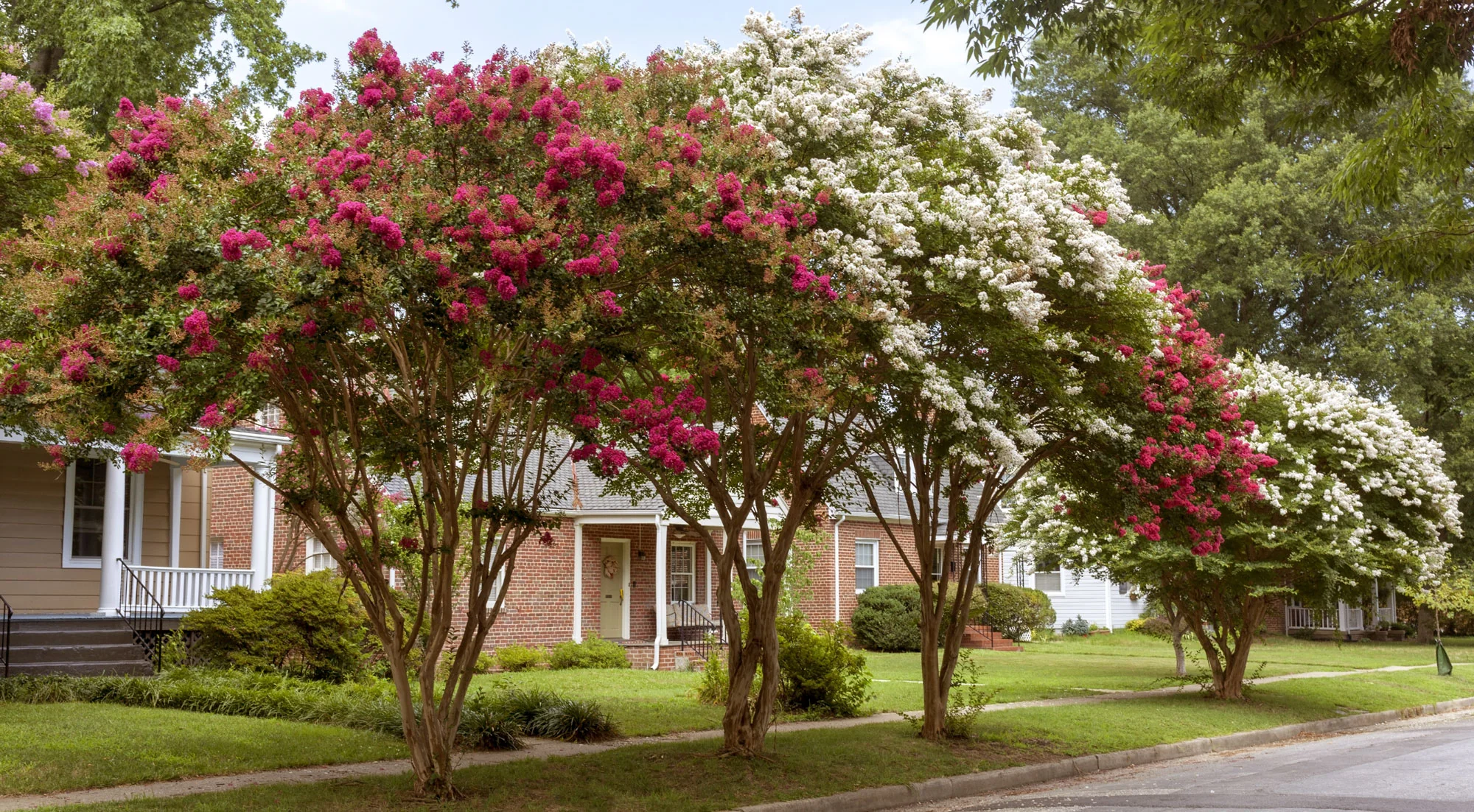
Crepe myrtles are among the most valuable and most stunning landscape trees available for North Texas residential properties. They handle heat, drought, alkaline clay soil, and the difficult conditions of this climate with composure that far more demanding trees cannot manage. They bloom for months — from June through September — with flowers in colors ranging from white through pink, red, and purple that are unmatched for summer flowering impact in the residential landscape. And they do all of this while developing a natural branching structure and smooth, exfoliating bark that makes them beautiful even in winter when dormant.
Topping destroys all of this. This blog explains exactly what topping does to crepe myrtles and what correct pruning looks like instead — and it explains how Lone Star Mow Co approaches crepe myrtle maintenance as part of our landscape services for clients across the region.
What Crepe Myrtle Topping Is and Why People Do It
Crepe myrtle topping — the practice of cutting the main structural branches back to stubs — has several origin stories depending on who is asked. Some homeowners do it because they observed it being done in their neighborhood and assumed it was the correct approach. Some do it because they believe the tree is too large for the space and need to "keep it small." Some do it because they were told by someone — often incorrectly — that it makes the tree bloom better or more prolifically.
None of these rationales hold up to examination.
The common large-growing crepe myrtle varieties — Natchez, Tuscarora, Muskogee, and others that can reach fifteen to twenty-five feet — are indeed large trees. But the correct response to a large-maturing tree being too large for its space is to replace it with a compact or dwarf variety, not to top it repeatedly in an attempt to contain it. Topping does not reduce a crepe myrtle's mature size — it redirects its growth energy into rapid, dense regrowth from the stubs that ultimately produces a more voluminous canopy, not a smaller one, while destroying the structural form of the tree.
The claim that topping improves bloom production has no scientific support. Crepe myrtles bloom on new growth produced in the current season — a correctly managed unpruned tree and a topped tree both produce new growth that blooms in summer. The topped tree's bloom production is not improved; it is produced on weak, rapidly grown sprouts from the stubs rather than on the structurally sound branching that correct pruning maintains.
What Topping Actually Does to the Tree
The damage from crepe myrtle topping is not purely cosmetic — it has real biological consequences that affect the tree's health and structure for the rest of its life.
When the main structural branches are cut to stubs, the tree responds by producing multiple new shoots from each cut end — sometimes six to ten or more from a single stub. These shoots emerge from the wound site and grow rapidly, driven by the root system's stored energy. Within a season or two, the formerly clean stub is covered by a dense cluster of thin, rapidly grown branches.
These new branches are not equivalent to the original structural branches they replaced. They lack the structural wood formation that develops over years in natural branch growth. They are attached to the stub by what are called "included bark" unions — connections that develop between the new shoot and the wound surface that are weaker than properly formed branch unions. As the new shoots grow over years, their weight increases while the attachment strength remains weak, creating progressively greater structural risk. Many heavily topped crepe myrtles eventually experience branch failures at the stub sites — the rapid-growth replacement branches snap or split under wind load or the weight of a wet flower head because the attachment was never structurally sound.
Additionally, the large wound surfaces created by stub cuts do not close over the way properly made pruning cuts close. Correct pruning cuts made at the branch collar — the slight swelling at the junction between a branch and the trunk or larger branch from which it originates — heal over predictably through the wound closure process. Stub cuts heal poorly, if at all, and the exposed wood of a large stub becomes a long-term entry point for decay organisms and pest activity that progressively weakens the central structural wood of the tree.
What Correct Crepe Myrtle Pruning Actually Looks Like
Correctly pruned crepe myrtles are beautiful, structurally sound, and require far less pruning intervention than the annual topping approach — because correct pruning allows the tree to develop its natural form rather than fighting it year after year.
The appropriate pruning work for most residential crepe myrtles is limited and specific:
Remove suckers at the base. Crepe myrtles regularly produce shoots from the root zone and at the base of the main trunks. These suckers detract from the visual clarity of the tree's form and compete with the main trunks for resources. They should be removed at their origin point annually.
Remove crossing or rubbing branches within the canopy. Branches that cross and rub against each other create wound sites that become entry points for decay. Removing one of the two conflicting branches — the smaller or more awkwardly positioned one — maintains canopy health without affecting the tree's overall form.
Remove dead or damaged wood. Winter-killed tips from cold events, broken branches, and dead wood within the canopy should be removed cleanly at their origin point.
Remove previous year's seed heads (the dried flower clusters that remain from last season) where they are present and accessible, as this improves the visual appearance of the emerging spring canopy.
That is it. For a properly sited crepe myrtle with adequate space for its natural mature form, these are the only pruning interventions that are necessary or beneficial. No structural branch removal. No height reduction. No "shaping." Just the maintenance work that removes the specific material that either harms the tree or detracts from its natural form.
The timing for this maintenance pruning is late winter — February is appropriate for most of North Texas, after the coldest period has passed and before spring growth begins. This allows the tree to direct its spring energy into healthy new growth rather than into healing pruning wounds.
What If the Tree Is Already Too Large for Its Space?
This is the underlying question behind most crepe myrtle topping decisions, and it deserves an honest answer.
If a large-maturing crepe myrtle variety has been planted in a space that is genuinely too small for it — against a foundation where it will eventually press against the structure, under a power line it will grow into, or in a space where its natural twenty-foot spread is incompatible with adjacent features — the correct long-term solution is replacement with a compact or dwarf variety, not repeated topping.
Dwarf and compact crepe myrtle varieties — selections like Pocomoke, Chickasaw, Hopi, and others — mature at three to six feet or six to twelve feet rather than the twenty to twenty-five feet of standard varieties. They provide the same bloom color, summer flowering season, exfoliating bark, and heat tolerance while fitting the space correctly without requiring containment pruning.
Replacing an oversized crepe myrtle with an appropriate compact variety is a one-time investment that produces better results permanently. Continuing to top an oversized standard variety produces worsening structural problems, increasingly grotesque form, and the same pruning requirement every winter indefinitely — and it never solves the underlying problem, which is that the wrong tree was planted in that space.
Lone Star Mow Co and Crepe Myrtle Care
Lone Star Mow Co's approach to crepe myrtle maintenance in our clients' landscapes is consistent with everything described above. When we perform hedge trimming and landscape maintenance services on properties with crepe myrtles, we do not top them. We perform the correct limited pruning — sucker removal, dead wood removal, crossing branch removal — that maintains the tree's health and natural form.
When we encounter clients whose crepe myrtles have been previously topped — which is common on properties that have had multiple service providers over the years — we have an honest conversation about the damage that has been done and the path forward. In most cases, the path forward is allowing the tree to develop the best form it can from its current state with correct maintenance going forward, rather than continuing the topping cycle. In cases where the structural integrity has been seriously compromised or the form is irreparable, we may recommend removal and replacement with an appropriate variety.
We also address crepe myrtle placement and variety selection in our landscape design and tree installation services — ensuring that new crepe myrtle installations use varieties that are appropriately sized for the specific location and will not require topping or containment pruning to remain appropriate for their space.

Have crepe myrtles in your landscape that deserve better care than annual topping? Lone Star Mow Co provides correct pruning as part of our professional landscape maintenance service.
Serving homeowners across Keller, Southlake, Haslet, Saginaw, Roanoke, Trophy Club, and the surrounding communities. Schedule your free consultation today.

Ready to Transform Your property?

Find Us On


