

Dollar Spot Fungus in North Texas Lawns: What It Is, Why It Spreads, and How to Stop It
Dollar Spot Fungus in North Texas Lawns: What It Is, Why It Spreads, and How to Stop It
Brown patch gets most of the disease attention in North Texas lawn discussions — and rightly so, given its dramatic overnight appearances and its prevalence in St. Augustine. But the second most commonly misdiagnosed fungal disease in this region affects Bermuda and Zoysia lawns specifically, and it is responsible for a significant amount of the irregular thinning, spotting, and general underperformance that homeowners attribute to drought, pests, or soil problems.
Dollar spot, caused by the fungal pathogen Clarireedia jacksonii (formerly classified as Sclerotinia homoeocarpa), is named for its characteristic damage pattern — small, roughly dollar-coin-sized spots of tan to straw-colored dead grass scattered across the lawn surface. In mild cases, the spots are distinct and separated. In severe outbreaks, the spots coalesce into larger irregular patches that can cover substantial areas and produce the lawn deterioration that requires real restoration to recover from.
Understanding dollar spot — what conditions it requires, how it spreads, and what the correct management response is — matters specifically for Bermuda and Zoysia homeowners across the North Texas service area.
What Dollar Spot Looks Like and How to Identify It
The characteristic appearance of dollar spot is distinct from both brown patch and drought stress, though in early stages it can be confused with both.
Dollar spot produces small, roughly circular spots in the one to two inch diameter range initially — the "dollar" reference — that have a straw-tan to bleached appearance. In Bermuda lawns, these spots are most visible in the morning when dew is present. Individual grass blades at the margin of active spots show a specific lesion pattern that is one of the most reliable identification features: an hourglass-shaped lesion that crosses the blade, with tan to bleached coloring in the center and water-soaked, reddish-brown margins on either side of the hourglass waist. This lesion pattern is diagnostic for dollar spot and distinguishes it from drought-related tip burn and other blade damage causes.
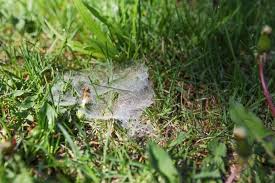
In morning dew conditions when dollar spot is actively spreading, white cottony mycelium — the fungal network — is sometimes visible spanning between grass blades in the active infection zone. This mycelium is characteristic of dollar spot and, when visible, is definitive confirmation of the disease.
As the disease progresses without management, individual small spots enlarge and adjacent spots merge, producing the irregular-shaped, straw-colored patches that are less distinctly circular than the initial stage and can resemble drought damage at a glance. The key distinguishing feature at this stage remains the individual blade lesion pattern visible at the advancing margins of the affected area — drought damage does not produce the hourglass blade lesion that dollar spot consistently creates.
The Conditions That Trigger Dollar Spot
Dollar spot is active across a wide temperature range — it can be present from mid-spring through fall in North Texas, though it peaks in the shoulder seasons (May through June and September through October) when temperatures are moderate and dew periods are extended. Unlike brown patch, which requires very high temperatures and extended moisture, dollar spot is most active during the moderate conditions of late spring and early fall.
Nitrogen deficiency is one of the most consistent predisposing factors for dollar spot severity. Underfertilized turf is significantly more susceptible to dollar spot than adequately fertilized turf — the fungal pathogen has a competitive advantage in nitrogen-limited conditions that reduces the turf's defensive response capacity. Lawns that are late on spring fertilization or that receive insufficient nitrogen through the growing season consistently show more severe dollar spot than adequately fertilized equivalent lawns.
Extended morning dew provides the leaf wetness that dollar spot spore germination and infection requires. Lawns in topographic positions that experience heavy dew due to cold air drainage — low spots that collect cool air overnight — show disproportionately higher dollar spot pressure than elevated positions on the same property. Improving drainage in these zones reduces dollar spot pressure.
Drought stress paradoxically increases dollar spot susceptibility. Moisture-stressed turf has reduced disease resistance capacity, making it more vulnerable to infection when dew moisture provides the necessary surface wetness for spore germination. The combination of stressed, nitrogen-limited turf with morning dew exposure is the classic dollar spot setup in North Texas conditions.
Compacted soil with poor root development reduces the turf's ability to access water and nutrients effectively — creating the nutrient-limited, stress-prone conditions that favor dollar spot. Annual aeration and topdressing that improves soil health reduces dollar spot susceptibility through the improved turf vigor that better soil supports.
How Dollar Spot Spreads
Dollar spot spreads primarily through mechanical transfer of the fungal mycelium and conidia (spores) from infected areas to healthy turf. The most common spread vectors in residential lawn maintenance are:
Mowing equipment that passes through an active dollar spot area and transfers the fungal material to adjacent healthy turf on the same or subsequent passes. This is one mechanism by which professional lawn maintenance equipment can contribute to disease spread if infected areas are mowed without any equipment hygiene consideration.
Foot traffic through active infection zones — the fungal material adheres to shoes and is deposited in adjacent areas as the person moves through the lawn.
Wind and water movement of the lightweight spores across the lawn surface.
This spread mechanism means that active dollar spot infections tend to expand progressively in the direction of mowing or foot traffic patterns, producing the directional spread that sometimes helps differentiate disease spread from other causes.
Correct Management: Fungicide and Agronomic
Fungicide application is the primary tool for active dollar spot control. Unlike some fungal diseases where environmental management alone can resolve the outbreak, dollar spot in active infection stages typically requires fungicide to halt the spread and allow the turf to recover.
Effective fungicide active ingredients for dollar spot in warm-season turf include propiconazole, azoxystrobin, thiophanate-methyl, and myclobutanil. Of these, azoxystrobin provides the broadest disease spectrum (also controlling brown patch and other fungal diseases), making it the preferred choice when multiple disease pressures are present. Propiconazole is highly effective specifically against dollar spot and provides good systemic activity when applied to actively growing turf.
Application timing matters significantly — fungicide applied at the first appearance of dollar spot symptoms is more effective than application after significant turf loss has occurred. Early identification is the management advantage that professional monitoring during maintenance visits provides.
Nitrogen management is the agronomic companion to fungicide treatment for dollar spot. Timely fertilization that maintains adequate nitrogen levels — particularly in the spring and fall shoulder seasons when dollar spot is most active — directly reduces the severity of outbreaks by improving the turf's baseline disease resistance. This is not an argument for excessive nitrogen — over-fertilization creates the conditions for other diseases — but for ensuring that the turf is not below the adequate nitrogen threshold that significantly increases dollar spot susceptibility.
Irrigation timing — specifically morning-only irrigation that allows the turf surface to dry completely during the day — reduces the extended leaf wetness period that dollar spot infection requires. Evening or overnight irrigation that maintains moisture on turf blades through the cool nighttime hours significantly extends the infection window for dollar spot during the shoulder seasons when it is most active.
How Lone Star Mow Co Addresses Dollar Spot
Dollar spot identification is part of the disease monitoring that Lone Star Mow Co incorporates into every maintenance visit during the active disease seasons — spring through fall. The characteristic blade lesion pattern, the small circular spot appearance, and the morning mycelium that confirm active dollar spot are all observable during maintenance visits and warrant immediate communication to the client when identified.
For properties where dollar spot is identified, we provide the fungicide treatment recommendation appropriate for the specific infection severity, the grass type, and the other agronomic conditions that are contributing to disease susceptibility. The combination of fungicide treatment and nitrogen management timing — addressing both the immediate outbreak and the predisposing conditions — produces the most effective and most durable response.

Noticing small bleached spots in your North Texas Bermuda or Zoysia lawn that spread between mowing visits?
Lone Star Mow Co can identify what's happening and provide the right treatment. Serving Keller, Southlake, Haslet, Saginaw, Roanoke, and Trophy Club. Schedule your free consultation today.

Ready to Transform Your property?

Find Us On


