

How Mowing Pattern and Direction Affect the Health and Appearance of Your Lawn
How Mowing Pattern and Direction Affect the Health and Appearance of Your Lawn
This is one of those lawn care topics that sounds like a minor detail until you understand the specific mechanisms behind it — and then it becomes a practice change you cannot unlearn. The direction and pattern in which a lawn is mowed affects the health of the turf, the visual appearance of the finished surface, and the long-term condition of the soil in ways that matter enough to address specifically.
It is not a dramatic impact in any single mowing event. But over the fifty or sixty mowing visits a North Texas lawn receives in a full growing season, the cumulative effect of always mowing in the same direction versus rotating the pattern regularly is visible — in the turf density, in the soil condition, and in the visual uniformity of the lawn surface.
The Problem With Always Mowing the Same Direction
When a lawn is mowed in the same direction and pattern on every visit — starting at the same edge, moving in the same rows or arcs, using the same turning patterns — several specific, compounding problems develop over time.
Soil compaction follows the mow pattern. Every pass of the mowing equipment compacts the soil slightly along the path of the mower wheels. Compaction reduces pore space in the soil, limiting water infiltration and oxygen exchange. When the mower always follows the same path, those wheel tracks receive compaction pressure on every visit rather than distributing that pressure across the lawn surface. Over a season of weekly mowing in the same pattern, the wheel track zones develop measurably greater compaction than adjacent areas. In North Texas's clay soil, which compacts readily even without directional concentration, this pattern-specific compaction adds to the baseline compaction problem that makes annual aeration necessary.
Grass develops a directional lean. Grass blades that are consistently cut while leaning in one direction develop a grain — the blades establish a directional lean as they grow back from repeated cuts in the same orientation. This grain is visible as a surface that reflects light differently from different angles — parts of the lawn look lighter or darker depending on the viewing angle — and produces an uneven-looking surface even when the mowing height is correct and consistent.
Ruts develop in soft or wet conditions. Wheel tracks that are repeatedly covered in the same pattern eventually develop visible ruts — slight depressions along the track path — particularly in lawns that are mowed when the soil is soft from recent irrigation or rainfall. These ruts create surface unevenness that is eventually visible even when the lawn is dry and creates the low-spot drainage problems described in the lawn leveling context.
The Benefits of Rotating the Mowing Pattern
Rotating the mowing pattern on each visit — alternating between north-south, east-west, and diagonal directions on successive visits — distributes all of these effects across the full lawn surface rather than concentrating them in fixed locations.
The compaction pressure from mowing equipment is spread across the full area rather than concentrated in fixed wheel tracks, reducing the pattern-specific compaction that develops with consistent direction.
The grass blades are cut from different angles on each visit, preventing the development of a consistent grain and producing a more uniform, visually even surface that reflects light consistently from all directions.
Rut formation is prevented because no specific path receives consistent repeated pressure that would allow depressions to develop and establish.
Professional lawn care operations rotate mowing patterns as a standard practice — not because of a rigid formula but because varying the approach on each visit is understood to produce better lawn health outcomes over the course of a season. Lone Star Mow Co's service crews follow this practice on every property we maintain.
The Visual Effect: Lawn Stripes and Pattern Appeal
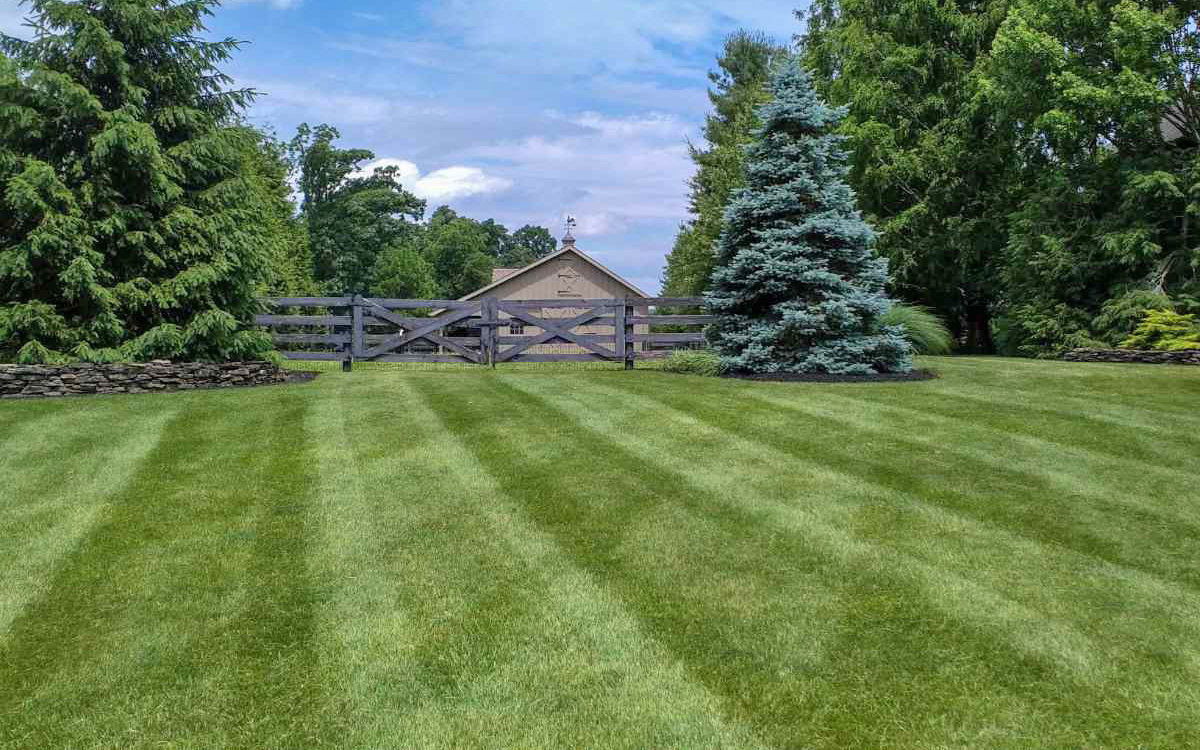
Mowing pattern also creates the decorative lawn stripe effect that professional turf managers use on sports fields, golf courses, and high-end residential properties. Lawn stripes are produced by the difference in light reflection between grass blades bent away from the viewer (appearing lighter) and grass blades bent toward the viewer (appearing darker) in adjacent mowing rows. The effect is produced by the mowing direction and can be enhanced by using a roller attachment that bends blades more definitively after cutting.
For residential lawns, the stripe effect is achievable on any properly maintained turf with a mowing direction that creates consistent light and dark bands. It requires mowing in straight, parallel rows rather than circular or random patterns, and the effect is most visible from a viewing angle perpendicular to the mowing direction.
Diagonal patterns — stripes running at 45 degrees to the property boundary — tend to create a visually dynamic effect that makes smaller lawn areas appear larger. Alternating between diagonal directions on successive visits produces a checkerboard-like pattern that many homeowners find particularly attractive.
The pattern aesthetics are a secondary benefit of varied mowing direction — but they are a genuine, visible benefit that adds visual interest to a well-maintained lawn without any additional cost or time beyond the attention to direction and pattern that professional service already incorporates.
Mowing Pattern and Scalping Risk
One specific pattern-related risk worth understanding is the relationship between turning radius and scalping at the turning points.
When a zero-turn mower — the type used by most professional lawn care operations — makes a pivot turn at the end of a mowing row, the inner wheel of the turn pivots in place while the outer wheel drives forward. This pivot motion on the inner wheel creates a scuffing motion on the turf surface that can damage grass tissue, particularly in areas where the soil is soft or where the grass is already under stress.
Rotating the direction of mowing distributes these pivot turn locations across the full lawn perimeter rather than concentrating them in the same corner areas on every visit. The same areas that receive the most pivot scuffing on a north-south mowing pass are different from the areas that receive it on an east-west pass — so rotating direction prevents the cumulative scuff damage that develops when the same corner areas receive pivot pressure on every visit.
This is a subtle point but a real one — the areas where lawn damage from mowing appears most often on residential properties mowed consistently in one direction are exactly where this concentrated pivot scuffing would be expected.
What This Means in Practice
The practical takeaway for homeowners managing their own lawns is straightforward: change direction on each mowing visit. The specific sequence is less important than the consistency of rotation — north-south one visit, east-west the next, diagonal the next, and back to north-south. Any rotation that prevents the same direction from being used on consecutive visits produces the distributing effect that protects soil health, turf condition, and visual uniformity.
For homeowners with professional service, this is a question worth asking a prospective lawn care company directly: do your crews rotate mowing patterns on each visit? Companies that understand turf health will answer yes without hesitation and will be able to explain why. Companies that are simply providing commodity mowing service may not have thought about it — which is itself an indicator of the service quality philosophy behind the operation.
Every Lone Star Mow Co maintenance visit incorporates pattern rotation as a standard practice — not as an occasional special attention, but as part of the professional service standard that we apply to every property we maintain.

Want professional lawn maintenance that covers every detail of technique — including the ones most services never think about?
Lone Star Mow Co delivers professional lawn care to homeowners across Keller, Southlake, Haslet, Saginaw, Roanoke, and Trophy Club. Schedule your free consultation today.

Ready to Transform Your property?

Find Us On


