

How Slope and Grade Affect Every Lawn and Landscape Decision You Make
How Slope and Grade Affect Every Lawn and Landscape Decision You Make
Most homeowners think about their outdoor property primarily at the surface level — the grass, the plants, the mulch, the edging. Grade and slope — the actual three-dimensional shape of the land — is the invisible context that determines how well all of those surface elements perform.
Water moves according to grade. Plant root zones experience the drainage conditions that grade determines. Soil erosion occurs at rates that slope steepness drives. The irrigation water that the homeowner pays for runs off in whatever direction the grade sends it. Lawn leveling needs, drainage problems, and erosion challenges are all fundamentally grade problems — and understanding grade as the foundational variable in outdoor property management changes how homeowners think about many of the surface-level problems they otherwise treat in isolation.
This blog is about the role of grade and slope in lawn and landscape decision-making — specifically the grade decisions that affect the specific services Lone Star Mow Co provides to homeowners across this area.
What Correct Grade Actually Means for a Residential Property
The foundational grade requirement for any residential property is positive drainage away from the structure on all sides. The soil surface adjacent to the foundation should slope away from the building — not steeply, but measurably. The standard recommendation from structural engineers and landscape professionals is a minimum two percent slope away from the foundation in the first ten feet from the structure. That translates to roughly two and a half inches of elevation drop over ten feet — subtle enough to be nearly invisible but sufficient to direct surface runoff away from the foundation rather than toward it.
This positive drainage gradient matters enormously in North Texas clay soil because clay's behavior with moisture — expanding when wet, contracting when dry — means that the relative moisture content of the soil surrounding the foundation is a direct driver of foundation movement. Consistent positive drainage keeps the moisture loading on the clay soil around the foundation relatively uniform, reducing the differential expansion and contraction that produces the foundation movement problems endemic to this region.
Properties where grade has settled, where initial construction grading was inadequate, or where years of soil movement have changed the original drainage direction frequently develop inward-draining zones adjacent to the foundation — and those properties show disproportionately higher rates of foundation-related issues over time.
Professional lawn leveling that corrects grade at the foundation perimeter is one of the most practically valuable services on a property with this problem — not merely cosmetically, but structurally.
How Slope Affects Plant Selection and Bed Design
Slope creates specific microclimatic and soil moisture conditions that directly affect which plants thrive in a sloped landscape area and how beds on slopes need to be designed to perform sustainably.
On steeper slopes — anything above roughly ten percent gradient — several compounding challenges affect landscape bed performance. Rainfall and irrigation water run off faster than the soil can absorb, meaning plants on slopes typically receive less effective moisture from precipitation events than flat areas receiving the same rainfall. Erosion removes the surface soil layer progressively with each runoff event, exposing roots and degrading the bed environment over time. And mowing on steeper slopes is a safety and equipment challenge that often leads to scalping at the high points of the slope where the mowing deck tips.
Plant selection for sloped beds requires prioritizing species with strong, fibrous root systems that anchor slope soil effectively, drought tolerance that compensates for the reduced effective moisture from runoff, and establishment characteristics that allow them to develop adequate root contact with the slope soil before the first summer.
For North Texas slopes, some of the most appropriate plant choices include ornamental grasses — Gulf Muhly, Mexican Feather Grass, and similar species that establish fibrous root systems quickly and handle dry conditions effectively — along with native groundcovers, spreading junipers, and selected shrubs with the root architecture to stabilize slope soil while providing visual coverage.
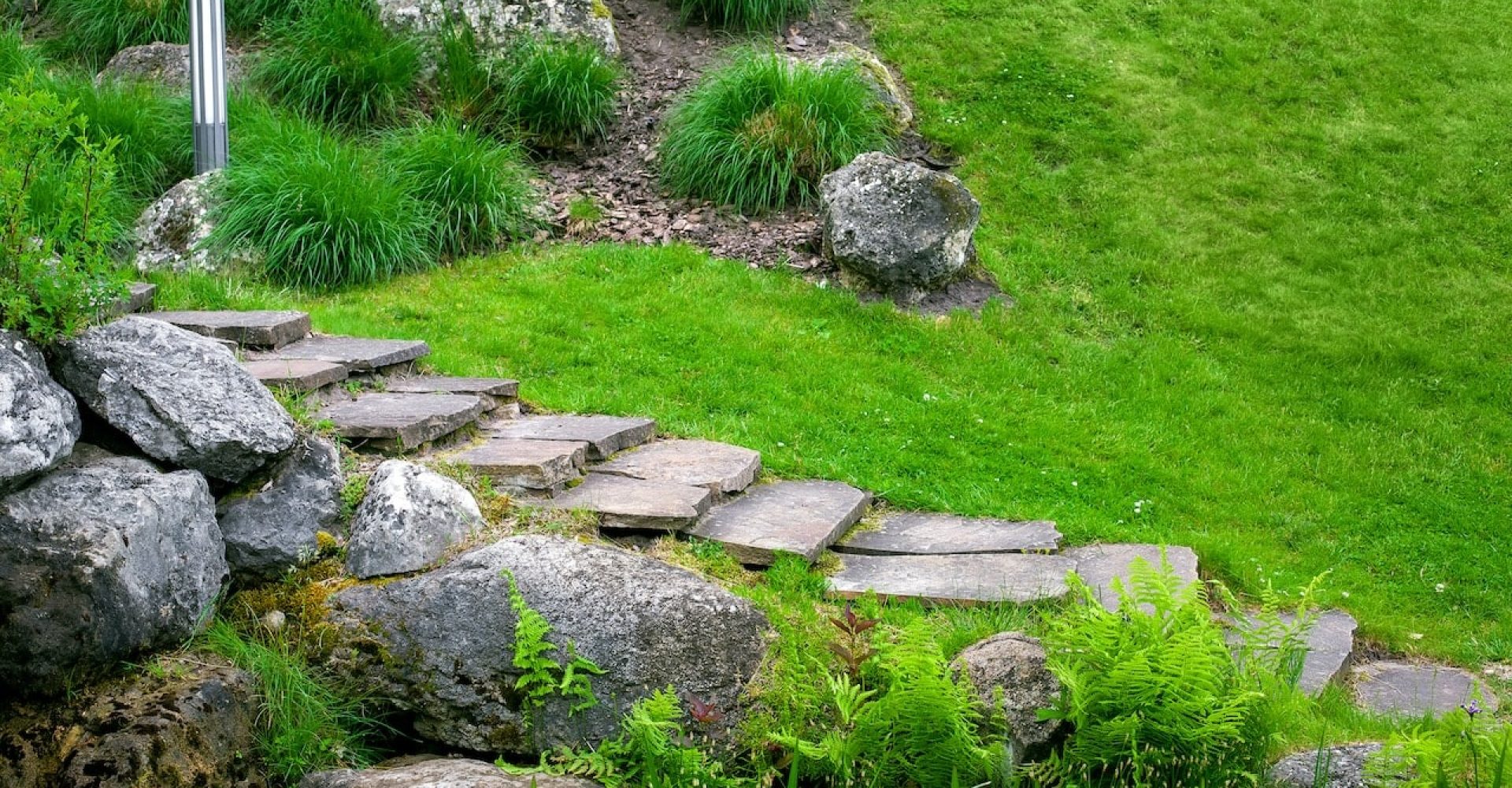
Ground cover decisions for slopes follow the same logic: any material that will erode with water movement is inappropriate for steep slopes. River rock at adequate depth is generally appropriate for drainage-facing slopes. Erosion-control mulch — shredded hardwood or similar material with longer individual fibers that interlock and resist movement — outperforms standard cedar mulch on slopes where water movement is a factor.
Grade and Lawn Drainage: The Invisible Variable in Weed and Disease Problems
A lawn's drainage pattern — determined by its grade — creates moisture conditions that directly influence weed pressure, disease risk, and turf density in ways that surface maintenance cannot correct.
Low spots that collect water create the anaerobic soil conditions that weaken grass roots, create fungal disease habitat, and — as discussed in the nutsedge section — favor the establishment of moisture-tolerant weed species. Nutsedge, in particular, is strongly associated with drainage low spots. A nutsedge population that recurs in the same location after repeated herbicide treatment is almost always in an area with a grade problem that maintains the moist soil conditions that nutsedge favors. The herbicide manages the above-ground population; the grade problem repopulates it every season.
High spots that drain too quickly — typically the crown areas of bumps and ridges in an uneven lawn surface — create drought stress conditions in those zones even during periods of adequate overall irrigation. The top of a Bermuda lawn ridge dries out faster than adjacent level areas, shows drought stress first, scalps under the mower deck, and struggles to maintain the density that makes weed competition sustainable.
Understanding these grade-related performance variations is part of the comprehensive lawn assessment that Lone Star Mow Co brings to new client consultations — identifying the specific areas where grade is contributing to the weed, disease, or turf health problems that surface maintenance alone cannot resolve.
Erosion as a Grade and Slope Problem
Erosion in residential landscapes is almost always a grade and slope problem compounded by inadequate ground cover. Bare or thinly covered soil on slopes, drainage channels without erosion-resistant materials, and bed edges where irrigation runoff concentrates all experience progressive soil loss that affects both the appearance and the health of the landscape.
The practical erosion control toolkit that Lone Star Mow Co's services address includes several approaches:
Ground cover at the correct depth on slopes — whether appropriate organic mulch with erosion-resistant fiber structure, river rock in drainage zones, or established plants with root systems that anchor the slope soil — is the fundamental erosion control approach for landscape beds.
Lawn maintenance that preserves turf density on slopes — correct mowing height that maintains the soil-covering canopy, annual aeration that improves root depth and density on compacted slope soils, and the monitoring that catches thinning early before erosion begins in bare zones.
Grade correction through lawn leveling that addresses the concentrated flow paths that create accelerated erosion in specific locations — filling and re-grading the channels that concentrate runoff before it reaches enough velocity to carry soil particles.

Is grade or drainage affecting the performance of your lawn and landscape in ways surface maintenance can't fix?
Lone Star Mow Co provides professional lawn leveling, site assessment, and the complete maintenance program that addresses the underlying conditions affecting your property. Serving Keller, Southlake, Haslet, Saginaw, Roanoke, and Trophy Club. Schedule your free consultation today.

Ready to Transform Your property?

Find Us On


