

Lawn Maintenance Service in DFW: What Every Homeowner Should Expect on Every Visit
Lawn Maintenance Service in DFW: What Every Homeowner Should Expect on Every Visit
There is a gap in the DFW lawn care market between what homeowners are paying for and what they are actually receiving — and most homeowners do not realize the gap exists until they either see a neighbor's professionally maintained lawn and wonder what is different, or until they switch from one provider to another and discover that the new team's visits cover a completely different scope than what they were used to.
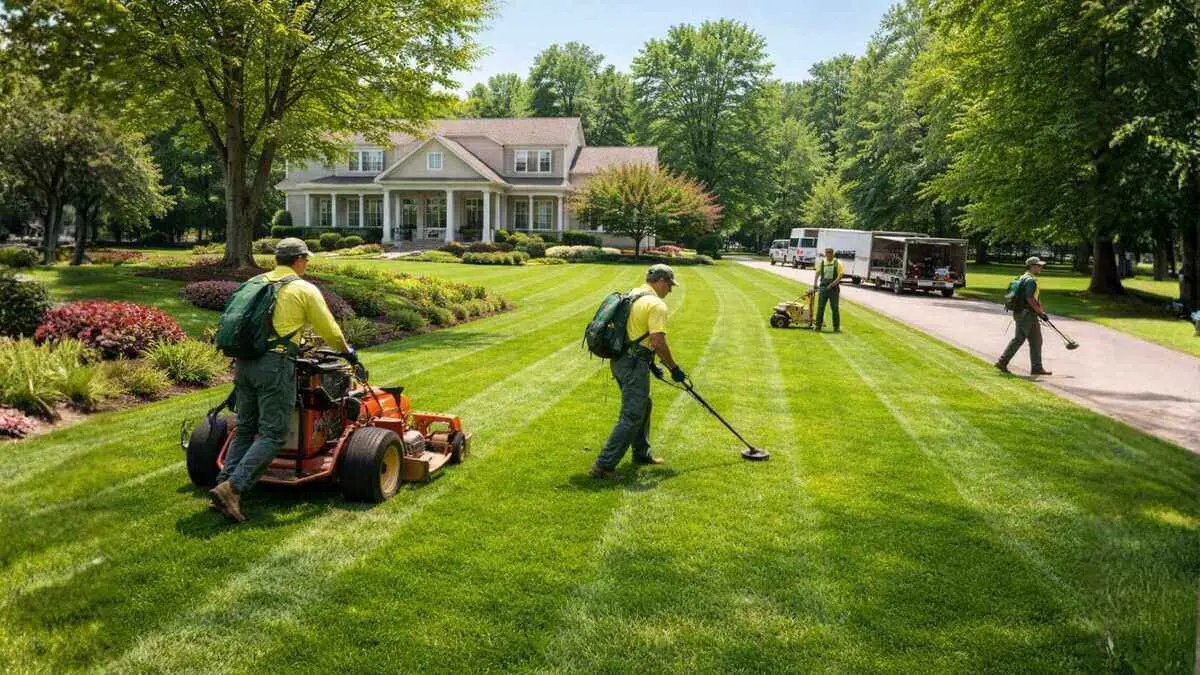
Lawn maintenance service in the Dallas-Fort Worth area ranges from a quick mow-and-go that takes fifteen minutes and covers only the grass height to a complete, multi-component professional service that addresses every visible detail of the property in every visit. The price difference between these two approaches is narrower than most homeowners expect. The result difference is massive and immediately visible.
This blog is a complete breakdown of what professional lawn maintenance service in DFW should include on every visit — and why each component matters to the appearance and health of your property across Keller, Southlake, Haslet, Saginaw, Roanoke, Trophy Club, and the surrounding North Texas communities.
Component 1: Mowing at the Correct Height for Your Specific Grass Type
The most fundamental component of any lawn maintenance service is the mowing itself — but the quality of the mowing depends almost entirely on whether it is done at the correct height for the specific grass type on your property. This is where most discount lawn maintenance services fail silently, because the homeowner typically cannot tell from looking at a freshly mowed lawn whether the height was correct or whether the mower was simply set to whatever height the crew runs for every property on their route.
DFW warm-season grasses have specific mowing height requirements that directly affect plant health, weed resistance, disease susceptibility, and drought tolerance. Bermuda grass performs best when maintained at one to two inches during the active growing season. At this height, Bermuda produces the tight, carpet-like density that makes it one of the most impressive-looking lawns available in North Texas. Cut shorter, it scalps and browns. Left taller, it becomes stemmy, open, and loses its distinctive visual quality.
St. Augustine must be maintained at three to four inches — the most important single mowing decision for this grass type and the one most frequently violated. St. Augustine's above-ground stolons — the runners that spread and maintain the lawn's density — are vulnerable to close cutting. Maintaining St. Augustine at correct height keeps these stolons protected, which keeps the lawn thick, green, and weed-resistant through the DFW growing season.
Zoysia falls in a range of one and a half to three inches depending on the variety installed on your specific property. Palisades Zoysia performs well at two to two and a half inches. Fine-bladed varieties like Emerald can be maintained at the lower end. Correct height for Zoysia means understanding what variety is on your property, not applying a generic middle setting.
The one-third rule applies without exception to all three grass types: never remove more than one-third of the grass blade in a single cutting pass. Violating this rule — which happens routinely on lawns that are allowed to grow too tall between visits and then corrected aggressively in a single pass — causes immediate turf stress, produces browning that lasts for days, and forces the plant to redirect energy from root development to blade recovery. A professional lawn maintenance service keeps the lawn within the one-third rule by maintaining consistent frequency that prevents excessive growth between visits.
Component 2: Sharp Equipment That Cuts Clean
Every time a lawn is mowed with a dull blade, the grass pays a price that becomes visible within twenty-four hours. A sharp blade makes a clean, precise cut through the grass blade, leaving a straight tip that stays green and healthy. A dull blade tears the grass, shredding tissue rather than cutting it cleanly, and leaving a frayed, ragged tip that turns brown quickly — a phenomenon called tip browning that gives mowed lawns a washed-out, yellowish cast rather than the clean green appearance a properly cut lawn shows.
Beyond aesthetics, torn grass tips are biologically compromised. The ragged tissue left by a dull blade is an entry point for the fungal pathogens that are already endemic in the DFW environment. Brown patch, dollar spot, and other turf diseases exploit damaged tissue for entry — meaning mowing with dull blades is not just a visual problem but a direct contributor to the disease pressure that St. Augustine and other DFW grass types already face.
Professional lawn maintenance companies use commercial-grade mowing equipment with maintained blades. The standard for blade sharpness in professional service is that every blade should produce a clean cut without tearing. Most homeowner mowers — and the consumer-grade equipment used by discount lawn maintenance operations — are not maintained to this standard. The difference in the cut quality shows immediately in how the lawn looks after service.
Component 3: Mechanical Edging Along Every Hard Surface
Edging is the component of professional lawn maintenance that most homeowners underestimate until they experience it consistently. The sharp, defined line between turf and driveway, turf and sidewalk, turf and curb — created with a dedicated mechanical edger rather than a string trimmer angled at the grass — is the detail that communicates professional maintenance from across the street.
In DFW, edging carries special importance because of Bermuda grass's aggressive spreading habit. Bermuda extends runners — both above-ground stolons and below-ground rhizomes — over and into hard surfaces persistently through every growing season. Without weekly mechanical edging creating a clean physical barrier, Bermuda progressively colonizes driveway edges and sidewalks, creating the thick, ragged grass overhang that takes much more significant corrective edging to address than the simple maintenance cut that consistent weekly edging requires.
Professional lawn maintenance service includes mechanical edging along every hard surface on the property on every visit. Not on alternating visits. Not when the crew has time. Every visit. The visual difference between a property edged weekly with a mechanical edger and one edged occasionally or with a string trimmer is obvious to anyone who looks — it is one of the clearest signals of professional service quality available on any residential property.
Component 4: Complete String Trimming of All Structures and Beds
Mowing covers the open lawn areas. Edging covers the hard surface boundaries. Trimming covers everything in between — the areas the mower cannot reach due to obstacles, structures, and boundaries. This includes tree bases and their surrounding area, fence posts, utility posts, mailboxes, utility boxes, AC unit bases, around any deck or patio supports, along fence lines where the mower cannot get close enough for a clean cut, and along the outer edge of all landscape beds.
In a typical DFW residential property, the untrimmed areas around these obstacles can represent fifteen to twenty percent of the total lawn area. Leaving them untrimmed — a common shortcut in discount lawn maintenance — creates the impression of an uncared-for property even when the main mowing area is well done. The tall, ragged grass around a tree base or along a fence line is the first thing a homeowner's eye finds when they pull into the driveway, and it undermines the entire appearance of the mowing work done in the open areas.
Professional lawn maintenance from Lone Star Mow Co covers complete trimming of every obstacle and boundary on every property on every visit. There are no selective areas that only get attention when there is time. The standard is complete coverage, every visit.
Component 5: Blowdown of All Hard Surfaces
After mowing, edging, and trimming, every professional lawn maintenance visit should end with a complete blowdown of all hard surfaces — driveways, sidewalks, walkways, patios, and any other paved area on the property. This step removes the grass clippings distributed across hard surfaces during edging and trimming, leaving the property clean rather than covered in organic debris that tracks into the home, stains concrete over time, and creates the cluttered appearance of an incomplete service.
This five-to-ten minute step is the difference between a property that looks professionally finished after service and one that looks like someone mowed it and left. Every Lone Star Mow Co visit ends with complete blowdown of every hard surface before the crew leaves the property.
Component 6: A Final Property Walkthrough
The property walkthrough is the quality control mechanism that closes every professional lawn maintenance visit. After all work is complete, a final walk of the property confirms that every step was completed to standard — edging is sharp on every hard surface, trimming is thorough around every obstacle, clippings are blown from every hard surface, and no areas were missed due to the distraction of the service process.
This walkthrough is also the mechanism for identifying anything on the property that warrants the homeowner's attention — early signs of turf stress, a developing disease patch, evidence of pest activity, a broken sprinkler head discovered during service. Professional lawn care that includes property observation as a standard service component provides value that goes far beyond the visible work of the visit itself.
Seasonal Adjustments That Make the Service Intelligent, Not Just Mechanical
Beyond the mechanics of each visit, professional lawn maintenance service in DFW includes the seasonal intelligence that makes the program work over time rather than simply maintaining a static approach through changing conditions.
In spring, the service transitions from bi-weekly winter frequency to weekly growing season frequency as growth rates accelerate with warming temperatures. The spring scalp — a lower-than-normal single mowing pass done in late February to early March — removes dormancy material and accelerates green-up. It is performed as part of the spring service transition, not as an add-on.
In summer, mowing height may be raised slightly during the peak heat stress months of July and August — half an inch above the normal target height reduces heat stress on turf by providing more shade to the soil surface and keeping root zone temperatures lower during the most demanding weeks of the DFW growing season.
In fall, the service transitions back to bi-weekly frequency as growth slows and warm-season grasses approach dormancy. The height setting for the final pre-dormancy mowing is adjusted to leave the grass at an appropriate height for winter — not too tall (which invites disease) and not too short (which exposes root systems to cold).
These seasonal adjustments are the mark of a lawn maintenance provider that understands the DFW growing cycle, not one that applies a uniform approach year-round regardless of what the grass actually needs.
Why Consistency Over Time Builds Something No Single Service Can
The compounding value of consistent, complete, professional lawn maintenance over a full DFW growing season is the element that most homeowners discover only when they experience it for the first time with the right provider. A lawn that receives complete professional service on every weekly visit for a full spring through fall season — always at the correct height, always cleanly edged, always completely trimmed — develops measurably different density, health, and visual quality than one receiving the same number of visits where corners were cut, heights were wrong, and edging was inconsistent.
This compounding effect is what produces the lawns in Keller, Southlake, and Trophy Club neighborhoods that stand out. It is not one impressive mowing pass. It is fifty of them, done correctly, consistently, throughout the season.
Lone Star Mow Co delivers professional lawn maintenance service with all six components — mowing at the correct height, sharp equipment, mechanical edging, complete trimming, blowdown, and property walkthrough — to every property in our DFW service area on every visit. No exceptions, no shortcuts, no selective service based on route pressure.

Ready for lawn maintenance service in DFW that actually covers every detail, every single visit?
Lone Star Mow Co provides professional lawn maintenance for homeowners across Dallas-Fort Worth. Schedule your free consultation today and let us show you what your property can look like.

Ready to Transform Your property?

Find Us On


