

Lawns With Dogs: How to Manage Pet Traffic, Urine Burns, and Digging in North Texas Turf
Lawns With Dogs: How to Manage Pet Traffic, Urine Burns, and Digging in North Texas Turf
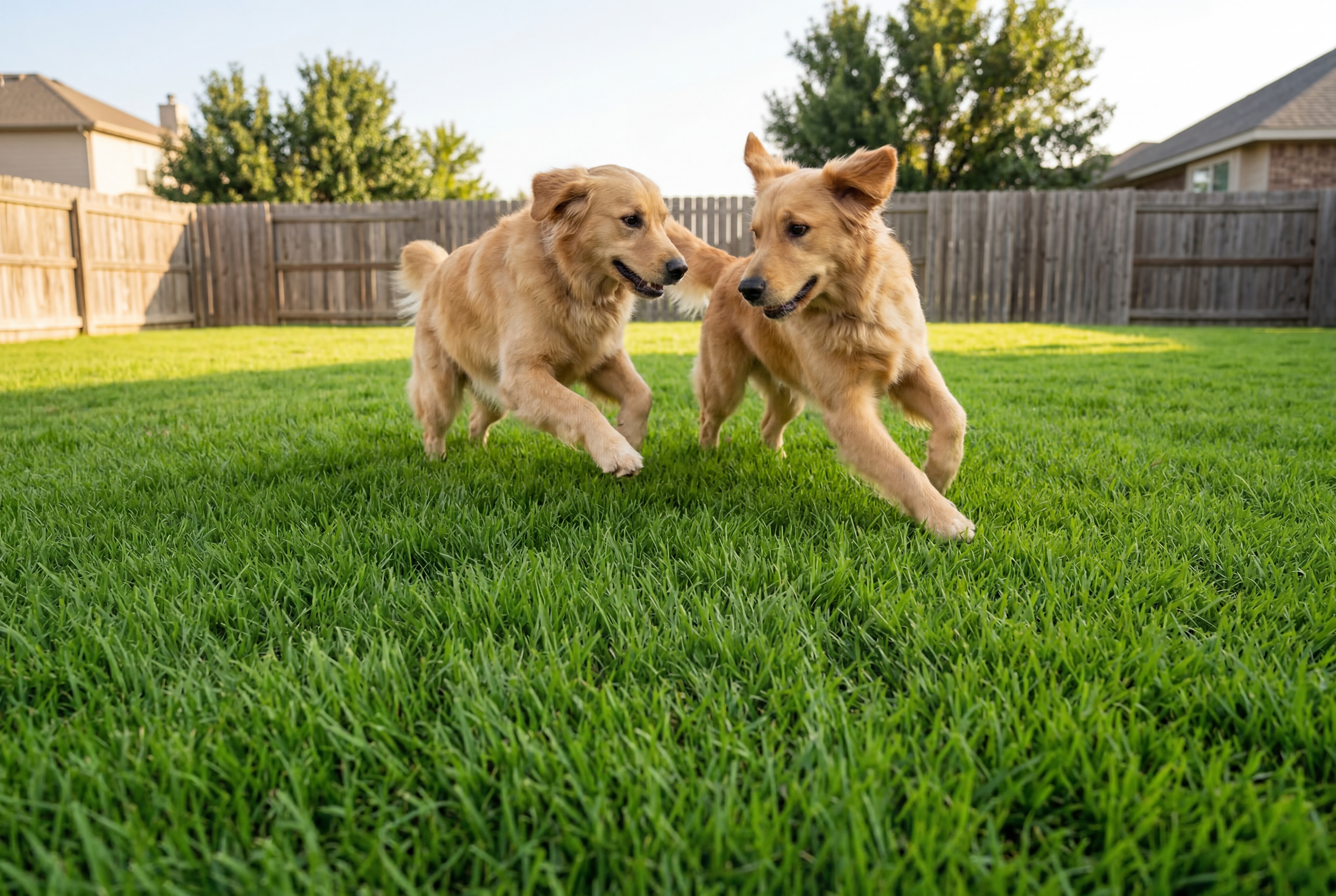
North Texas homeowners with dogs face a specific set of lawn challenges that are predictable, recurring, and genuinely frustrating if addressed incorrectly — or accepted as permanent features of having pets rather than manageable problems with practical solutions.
The three most common dog-related lawn problems — urine burns, high-traffic wear patterns, and digging — each have different causes, different damage mechanisms, and different correct responses. Treating them all as the same problem (the dog damaged the lawn) rather than as distinct issues with distinct solutions leads to the generic recommendations that do not actually work.
This blog covers each problem with the specificity it requires — what causes it, why it looks the way it does, what homeowners can do to reduce damage, and how professional lawn maintenance supports the management and recovery process that keeps dog-owner lawns looking better than resigned acceptance suggests is possible.
Understanding Urine Burns: The Chemistry Behind the Damage
Dog urine burns are caused by the combination of high nitrogen concentration and salts in the urine — not by acidity, which is the most commonly cited explanation and also the most commonly wrong one. This distinction matters because treatments aimed at soil pH correction (lime, for example) do not address the actual damage mechanism and do not produce the recovery that homeowners expect from them.
The nitrogen in dog urine functions like an extremely concentrated, uncontrolled fertilizer application to a small area. The same element that makes fertilizer produce green growth — nitrogen — kills grass when delivered at excessive concentration to a single spot. The initial response in many cases is actually a darker green ring around the central burn spot — the diluted outer ring receiving a stimulating nitrogen dose while the concentrated center receives enough nitrogen to produce fertilizer burn and death.
Female dogs and any dog that squats to urinate — including young dogs and older dogs — deliver concentrated urine to a single location, producing the characteristic circular or oval burn pattern. Male dogs that leg-lift on vertical surfaces distribute urine more broadly and tend to cause less concentrated lawn damage, though shrubs and tree trunks receiving direct urine contact over time develop their own stress responses.
What actually helps reduce urine burn damage:
The most effective immediate intervention is irrigation dilution immediately after urination occurs — thoroughly flushing the urine spot with the hose before the concentration can persist long enough to cause chemical burn. This requires being present to observe the urination event and act within a few minutes, which is practical for some households and impractical for others.
Raising mowing height reduces sensitivity to urine concentration by increasing the total leaf tissue that dilutes the nitrogen contact before it reaches the crown. Bermuda maintained at two inches rather than one inch shows less visible burn from equivalent urine events. This is the maintenance adjustment that Lone Star Mow Co can implement in households where dog urine damage is a persistent concern.
Designated alternative areas — a section of the yard surfaced with pea gravel or coarse decomposed granite where dogs are trained to urinate rather than on the grass — are the most effective long-term management tool for households where multiple dogs or consistent single-location urination makes dilution impractical. Professional landscape installation of a clearly defined, appropriately surfaced dog area in an accessible but out-of-primary-view location addresses the source of the problem rather than managing the damage indefinitely.
Recovery of damaged spots requires removing the dead grass material from the burn center, flushing the soil thoroughly to dilute the accumulated nitrogen and salt concentration, allowing the soil to recover for several days, and then either allowing Bermuda's natural spreading from adjacent healthy turf to fill the spot (which typically takes two to four weeks in active growing season) or installing small sod patches where the recovery timeline is unacceptable.
High-Traffic Wear Patterns: The Compaction and Root Damage Problem
High-traffic wear patterns — the paths that dogs wear into the grass surface by running the same routes repeatedly — are compaction and root damage problems rather than chemical problems. Every pass of a dog along its established patrol route compresses the soil slightly, reduces pore space, and stresses the root system through the physical disturbance of the soil immediately below the grass surface.
The characteristic appearance of a dog traffic path is thinning grass along the route, with the most heavily trafficked sections eventually losing turf coverage entirely down to bare soil. On the bare soil sections, compaction reaches the point where grass cannot re-establish without intervention — the soil is too dense for new root penetration.
The management approach for traffic wear patterns:
Core aeration specifically targeting the worn path areas relieves the compaction that prevents recovery and allows new root establishment. Without compaction relief, sod installed or seed planted on a worn path simply encounters the same conditions that depleted the original turf — the new grass establishes at the surface but cannot develop the root depth that sustains it under continued traffic.
Professional lawn maintenance that raises mowing height in traffic areas reduces stress on the frequently disturbed root system — taller grass has more reserves and more root depth to withstand mechanical disturbance than grass cut to minimum height. This is a specific height adjustment Lone Star Mow Co can implement rather than applying uniform height across the full property.
Sod installation on bare compacted path sections, combined with the aeration treatment that creates the conditions for root establishment, provides the fastest restoration of turf coverage in traffic-worn areas. Small sod patches cut to the dimensions of the worn path sections and installed after aeration treatment recover and integrate with adjacent healthy turf within two to four weeks of active growing season.
Traffic management through landscape design — creating defined dog runs surfaced with materials that handle heavy pet traffic without damage (decomposed granite, river rock, rubberized surface materials) along the routes that dogs naturally prefer — is the permanent solution for properties where pet traffic patterns are fixed and grass is not a realistic option for those specific paths.
Digging Damage: The Most Behaviorally Complex Problem
Digging damage is distinct from urine burns and traffic wear in that it has a behavioral cause rather than a purely physical or chemical one — dogs dig for specific reasons, and the landscape management approach is most effective when it addresses the motivation as well as the damage repair.
Dogs dig most commonly for three reasons: cooling (digging to reach the cooler soil below the surface during hot weather), prey/scent motivation (grubs, moles, and other underground activity triggering digging in specific spots), and boredom/anxiety (repetitive digging in the same location without an apparent environmental trigger).
Cooling-motivated digging is most common during North Texas summer heat and is most effectively managed by providing shade and cooler outdoor areas — a shaded patio, a covered structure, or tree canopy in the area where dogs spend time. Dogs that have access to cool, shaded outdoor areas dig significantly less than dogs confined to full-sun exposure during peak heat hours.
Prey/scent-motivated digging is directly connected to the grub and mole activity in the turf — dogs are reacting to underground movement and scent that is genuinely present. Addressing the grub population through professional insecticide treatment eliminates the stimulus that drives grub-motivated digging. Mole control requires a different approach, but the principle is the same: addressing the underground activity reduces the trigger for surface digging.
Damage repair for digging holes in North Texas turf follows the same approach as other bare spot restoration: loosen compacted soil at the hole bottom, fill to grade with appropriate compost-sand blend material rather than straight soil or fill dirt, water thoroughly to settle, and install sod patch or allow natural spread from adjacent Bermuda to fill the restored surface.
How Professional Maintenance Supports Pet-Damaged Lawns
Every professional lawn maintenance program provides specific services that support the management and recovery of pet-damaged lawns:
Weekly maintenance at the adjusted mowing height that reduces burn sensitivity and traffic stress applies to every visit, not just when damage is visible.
Spring core aeration and topdressing that relieves the compaction from pet traffic along worn routes is the foundational soil treatment that makes recovery possible in traffic-damaged areas.
Sod installation service for specific urine burn centers and digging damage spots that require immediate restoration.
The professional observation during every maintenance visit that catches developing problems — a new urine burn spot before it expands, wear pattern thinning before it reaches bare soil, grub activity before it triggers extensive digging — and communicates these to homeowners with specific management recommendations.
Dog ownership and beautiful lawns are not mutually exclusive in North Texas. They require specific management knowledge and a service partner who understands that pet households have specific, predictable maintenance needs beyond what standard programs address. Lone Star Mow Co serves pet-owning homeowners across Keller, Southlake, Haslet, Saginaw, Roanoke, and Trophy Club with the expertise and services that make this combination work.

Have dogs and want a lawn that still looks its best? Lone Star Mow Co has practical solutions for pet-related lawn challenges.
Schedule your free consultation today. We serve Keller, Southlake, Haslet, Saginaw, Roanoke, Trophy Club, and the surrounding communities.

Ready to Transform Your property?

Find Us On


