

Moles and Voles in North Texas Lawns: What's Making the Tunnels and What to Do About It
Moles and Voles in North Texas Lawns: What's Making the Tunnels and What to Do About It
There is a category of lawn damage that North Texas homeowners discover by walking across what looks like a normal lawn and finding one or more of the following: a soft, raised ridge in the turf surface that was not there yesterday; a series of holes in the ground with displaced soil around them; irregular patches of dead grass with the root system eaten away; or a network of surface channels pressed into the lawn that radiate outward from a central point.
These are the calling cards of two small mammals — moles and voles — that are present in North Texas residential landscapes and that cause distinctly different types of lawn damage through distinctly different behaviors. Confusing one for the other produces management responses that are ineffective because the biology and behavior of each species require different control approaches.
This blog covers how to correctly identify mole versus vole activity, what each species is actually doing in your lawn, and what management approaches produce genuine control.
Moles: The Insect-Feeding Tunnelers
Moles (primarily the Eastern mole, Scalopus aquaticus) are small, largely underground-dwelling insectivores — they feed almost exclusively on earthworms, grubs, and other soil-dwelling invertebrates. They are not rodents and they do not eat plant material. The mole's damage to a lawn is entirely incidental to its food-seeking behavior: in tunneling through the soil in search of invertebrate prey, it creates the raised surface ridges and loosened soil channels that are its most visible calling card.
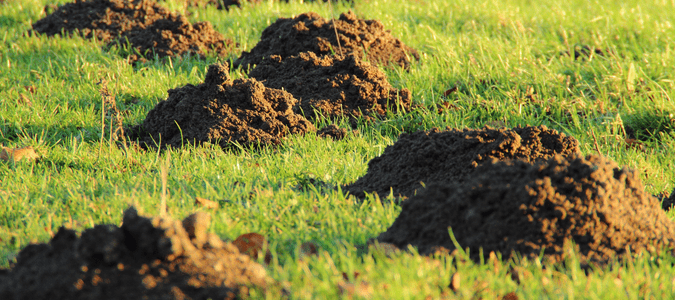
What mole activity looks like: The characteristic mole sign is a raised, volcano-like mound of loose soil pushed up from below — the spoil pile from a mole digging a new tunnel — and the associated surface ridge that extends from the mound along the tunnel path. The ridge is soft and yielding when pressed down; if it rises back within a day or two, the tunnel is actively in use. If it does not rise after being pressed, the tunnel may have been abandoned.
Moles in North Texas are most active in the cooler months of fall and spring when earthworm activity is highest in the upper soil layers. Summer heat and dry conditions drive earthworms and other prey deeper into the soil, and moles follow them — activity at the visible surface level decreases through peak summer but the animals remain present.
The critical misunderstanding about moles: Most homeowners assume that grub populations are the reason moles are present in their lawn — the logical connection between "grub-eating mole" and "grub population" seems to imply that grub control will eliminate the mole pressure. This is partially but not completely accurate. Moles primarily eat earthworms rather than grubs — earthworms are their preferred food source, and a lawn with a healthy earthworm population is actually more attractive to mole foraging than a grub-infested but otherwise biologically depleted soil. Grub control reduces one component of the mole's food supply but does not eliminate the earthworm population that is the primary attractant.
What actually controls moles: The most reliably effective mole control method is trapping — specifically scissor-jaw or harpoon-style mole traps placed in actively used surface tunnels. Identify an active tunnel by pressing down the ridge, marking the location, and checking within twenty-four to forty-eight hours. If the ridge has risen (the mole has re-opened the tunnel), place the trap. Trapping requires some patience and trial of different tunnel locations but is the most direct and most permanent method available.
Repellent castor oil products applied to the lawn create an unpalatable soil environment for the soil invertebrates moles feed on, reducing the food supply and discouraging continued foraging in treated areas. These products are less reliably effective than trapping and require re-application, but they are a non-lethal management option that some homeowners prefer.
Voles: The Plant-Eating Surface Runners
Voles (commonly the prairie vole, Microtus ochrogaster, and the woodland vole, Microtus pinetorum) are rodents — small mouse-like animals that feed primarily on plant material, including grass stems and roots, garden plants, tree bark, and bulbs. They cause fundamentally different damage than moles because their food source is the lawn and landscape itself.
What vole activity looks like: Voles create surface runways — narrow, closely cropped channels pressed into the grass at the soil surface level — that follow the routes they travel repeatedly through the turf. These channels are typically one to two inches wide, have the grass clipped to near-ground level within the channel, and often connect to entry holes approximately one and a half inches in diameter that lead to the shallow underground burrow system.
The grass damage from voles is more direct and more visible than mole damage — the turf along vole runways is eaten, not just displaced. Irregular patches of dead or dying grass with the roots and crowns eaten indicate active vole feeding. In landscape beds, vole damage to bulbs, perennial root systems, and the bark of young trees and shrubs (which they girdle at the base) can be severe.
Voles are most active and most damaging in the winter months — particularly in areas with ground cover that provides concealment from predators. Dense ornamental grass plantings, heavy leaf accumulation, thick ground cover plants, and unmowed or overgrown turf provide the protective cover under which vole populations build and from which they damage the adjacent lawn and landscape.
What actually controls voles: Habitat modification is the most effective long-term vole management tool. Removing the dense ground cover, accumulated leaves, and overgrown vegetation that provides predator-concealing cover reduces vole population support significantly. Mowing turf at appropriate height — not allowing tall grass that provides vole habitat — and removing the leaf accumulation that winter vole populations hide under are preventive management measures that reduce property attractiveness to vole colonies.
Rodenticide bait placed in tamper-resistant stations in the areas of active vole activity provides direct population reduction. Rodenticide baiting requires appropriate product selection (products labeled for vole control), correct station placement, and child and pet safety consideration — a professional application is preferred over homeowner self-application for this reason.
Exclusion — wrapping the trunks of young trees and shrubs with hardware cloth or commercial tree guards at and below the soil surface level — protects individual high-value plants from the girdling damage that voles cause at the base of woody plants. This is particularly relevant for newly installed trees and shrubs in their first winter on a property with known vole pressure.
The Role of Professional Lawn Maintenance in Mole and Vole Management
Professional lawn maintenance reduces vole habitat directly — the correct mowing height maintenance that keeps the turf surface at the one to three inch range for warm-season grasses provides significantly less protective cover for vole movement than overgrown turf. Leaf cleanup that removes the accumulation that vole populations over-winter in — particularly the November and February Live Oak leaf cleanup described in the leaf cleanup blog — eliminates a critical component of vole habitat on properties where that accumulation would otherwise persist through winter.
Lone Star Mow Co's professional monitoring during maintenance visits includes observation for the surface signs of mole and vole activity — the raised ridges, the surface channels, the entry holes near landscape beds — and communication to the homeowner when these signs are identified. Early identification allows management response before populations build to the levels that produce significant turf and landscape damage.

Noticing tunnels, surface ridges, or dead grass patches that might be mole or vole activity on your North Texas property?
Lone Star Mow Co identifies the cause and advises on the correct management response. Serving Keller, Southlake, Haslet, Saginaw, Roanoke, and Trophy Club. Schedule your free consultation today.

Ready to Transform Your property?

Find Us On


