


The Science of Watering Your North Texas Lawn: Depth, Frequency, and Why Most Homeowners Get It Backwards
The Science of Watering Your North Texas Lawn: Depth, Frequency, and Why Most Homeowners Get It Backwards
Of all the things a homeowner can do to undermine an otherwise well-maintained lawn, incorrect watering is the most consistently damaging — and the most consistently misunderstood. The intuition most people bring to lawn irrigation is the same intuition they bring to watering houseplants: water when it looks dry, water regularly, water generously. In a container plant context, this intuition is approximately correct. In a lawn context in this climate, it produces some of the most predictable and most preventable lawn problems that Lone Star Mow Co encounters on properties across Keller, Southlake, Haslet, and the surrounding communities.
The science of proper lawn irrigation — specifically the deep, infrequent watering approach that produces genuinely healthy warm-season turf — is not complicated once understood. But it runs counter to the intuitive approach in almost every dimension, which is why it requires explanation rather than assumption.
Why Shallow, Frequent Watering Is the Default — and Why It Fails
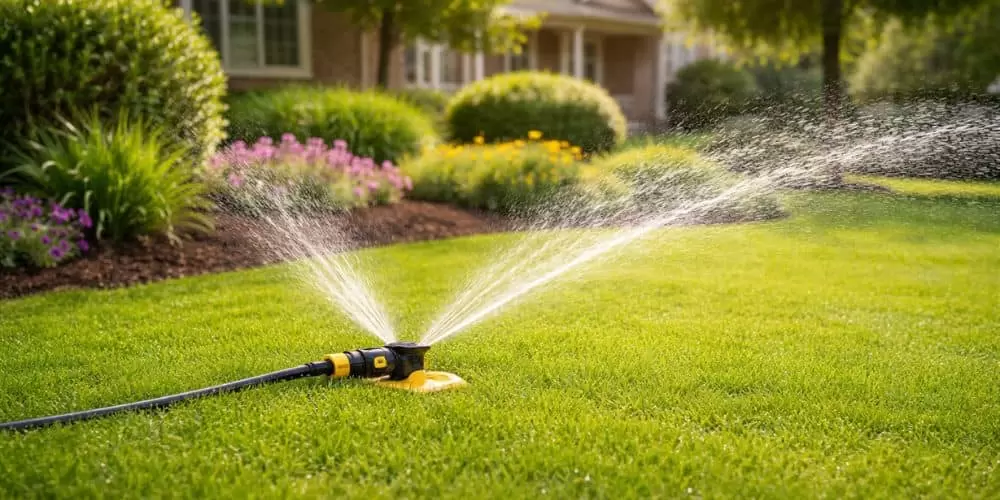
The most common lawn irrigation pattern Lone Star Mow Co observes on residential properties is what can be described as shallow and frequent: irrigation systems set to run for fifteen to twenty minutes per zone, every day or every other day, delivering small amounts of water across the lawn surface on a regular schedule.
This pattern feels like responsible care. The lawn is being watered consistently. The surface never appears dry for more than a day at a time. The grass usually looks acceptable.
What is actually happening beneath the surface is significantly less optimal. Fifteen to twenty minutes of irrigation from a typical residential system delivers roughly one-quarter to one-third inch of water to the lawn — enough to wet the surface of the soil to a depth of two to three inches. This moisture is available to the grass root system for the next twenty-four to thirty-six hours, after which the upper soil layer dries out and the cycle repeats.
Grass roots — specifically the warm-season grasses that dominate residential lawns in this climate — grow toward moisture. Where moisture is consistently available, roots grow. Where moisture is absent, roots do not extend. A lawn receiving shallow, frequent irrigation has consistently moist soil in the top two to three inches and dry soil below that level. Over a growing season of this irrigation pattern, the grass root system concentrates almost entirely in the shallow moist zone — two to three inches deep — because there is no reason for roots to extend further down.
A grass plant with a two to three inch root system is in a fundamentally precarious position. Two inches of moist soil is the first zone to dry out during a period of elevated heat, wind, or reduced irrigation. It is the first zone to become saturated during heavy rainfall that then produces fungal disease conditions. It is the zone most affected by soil surface temperature extremes — in North Texas's summer, the top few inches of soil can reach temperatures that stress and damage shallow-rooted grass.
The same grass plant with a six to eight inch root system — which deep watering produces — accesses moisture from a significantly deeper and more temperature-stable soil zone. It can endure three to four days without irrigation before reaching stress levels, rather than twenty-four to thirty-six hours. Its roots access nutrients distributed through a much deeper soil profile. It is meaningfully more heat and drought tolerant — not because of the grass variety or the fertilization program, but because of the irrigation habit that shaped its root architecture.
The Deep, Infrequent Alternative: What It Is and How It Works
Deep, infrequent watering is the irrigation approach that produces the root depth and resilience just described. The concept is straightforward: deliver adequate water volume in each irrigation event to wet the soil to a meaningful depth — four to six inches — and then allow the soil to partially dry between events before irrigating again.
For Bermuda grass, the target water delivery is approximately one inch per week total during the active growing season. One inch of water, applied in one to two sessions per week rather than distributed across daily light applications, penetrates North Texas clay soil to a depth of four to six inches — the zone where Bermuda roots need to develop to build the heat and drought tolerance characteristic of a well-managed lawn.
For St. Augustine, the target is slightly higher — approximately one and a half inches per week — due to its higher intrinsic water requirement relative to Bermuda.
For Zoysia, the target falls between the two, at approximately one to one and a quarter inches per week during the active growing season, reducing significantly during the cooler months as the grass enters dormancy.
The partial drying between irrigation events is as important as the depth of each application. When the upper soil layer partially dries between waterings, roots experience a mild stress signal that stimulates extension growth — the root tip extends deeper into the soil searching for the moisture that is no longer available near the surface. This root extension is the mechanism that builds the deep root architecture that distinguishes well-managed lawns from shallow-rooted ones.
This is a counterintuitive outcome: mild and brief moisture stress between irrigation events makes the lawn more drought tolerant in the long run by stimulating the root development that provides access to deeper soil moisture reserves.
How to Know Whether You Are Watering Correctly
Several observable indicators help homeowners evaluate whether their current irrigation approach is producing the deep root architecture and proper soil moisture conditions that healthy North Texas turf requires.
The screwdriver test is the simplest field assessment for soil moisture penetration. Take a standard ten-inch screwdriver and attempt to push it straight into the lawn surface in several locations. In adequately watered soil, a screwdriver penetrates easily to its full length without force. In dry or compacted soil, it meets resistance after two to three inches. The depth at which resistance is felt approximates the depth of available moisture in the soil — and correlates directly with how deep the grass root system is developing.
If the screwdriver meets significant resistance at three inches after a recent irrigation event, the irrigation is delivering water to only three inches of soil depth — which confirms shallow root development. If it penetrates easily to six inches, the moisture is reaching the depth where productive root growth occurs.
The blade curl test assesses when the lawn needs irrigation rather than whether irrigation timing is correct. Warm-season grasses show a specific stress response before browning — the grass blades curl or fold lengthwise, reducing their surface area to conserve moisture. When this curling is visible across the lawn, it indicates the grass is experiencing mild drought stress and irrigation is needed within the next day or two.
Waiting for blade curl to appear before irrigating — rather than irrigating on a fixed schedule regardless of soil moisture status — trains the lawn to use its root system more efficiently and ensures irrigation events are timed to actual need rather than calendar. Combined with the deep application depth approach, this produces the most water-efficient and turf-health-promoting irrigation pattern available.
The tuna can test is the standard method for calibrating irrigation system run time to deliver the target one inch of water. Place two or three empty tuna cans (standard height of one inch) at different locations across the irrigation zone and run the irrigation system. The run time required to fill the cans to the top represents the run time needed to deliver one inch of water from that zone. This simple calibration often reveals that irrigation systems running for fifteen to twenty minutes are delivering considerably less than one inch of water — and that the run time needs to be significantly longer per session to achieve the target depth.
Timing Matters: Why Morning Irrigation Consistently Outperforms Evening
The time of day that irrigation is applied affects both the efficiency of water delivery and the disease risk associated with moisture on grass blades and in the thatch layer.
Morning irrigation — specifically the window between five and ten AM — represents the optimal window for several reasons that compound each other. Air temperatures during early morning are lower than midday, which means evaporation rates during irrigation are significantly lower. More of the water applied reaches the soil rather than evaporating before it can penetrate. Wind speeds are typically lower in early morning, reducing the drift and uneven distribution that can occur in afternoon or evening irrigation.
More importantly, morning irrigation allows grass blades to dry completely as temperatures rise through the day. Moisture on grass blades during the cool, moderate nighttime period — which is what evening irrigation produces — creates the conditions that fungal pathogens require for establishment. Brown patch, dollar spot, and other fungal diseases that affect North Texas lawns are significantly more prevalent and more severe on lawns that receive regular evening irrigation than on equivalent lawns watered only in the morning.
The practical instruction is straightforward: always water in the morning. For homeowners with automatic irrigation systems, auditing the schedule to confirm morning-only operation — and adjusting any zones set to run in the afternoon or evening — is one of the most impactful disease risk reductions available without any service or product cost.
Soil Condition Affects Irrigation Effectiveness
Even a correctly timed, correctly calibrated irrigation program produces suboptimal results when applied to compacted North Texas clay soil. Compacted clay resists water infiltration — water applied to a compacted clay surface runs off or pools rather than infiltrating to the depth where roots need it. The irrigation event that should be delivering moisture to six inches of soil depth may be delivering it to two inches because the compacted soil cannot absorb the application rate fast enough.
This is one of the least obvious reasons that annual core aeration dramatically improves lawn performance — the physical channels created by aeration tines allow irrigation water to bypass the compacted clay surface layer and enter the soil profile at depth. A well-aerated lawn absorbs irrigation water more completely and more efficiently than a compacted lawn receiving identical irrigation volume.
For North Texas homeowners observing pooling or runoff during irrigation, the first question to ask is whether the problem is irrigation rate (applying water faster than the soil can absorb it) or soil condition (compaction that limits absorption capacity regardless of rate). Annual aeration addresses the latter — and for the first one to two growing seasons after aggressive aeration treatment on a long-neglected, severely compacted property, the improvement in irrigation efficiency and soil water distribution can be dramatic.
How This Connects to Lone Star Mow Co's Service Programs
Irrigation management intersects with several Lone Star Mow Co services in ways that homeowners benefit from understanding.
The annual core aeration and topdressing program we provide is the foundational service for improving soil absorption capacity — making every irrigation dollar more effective by allowing water to reach the depth where root development occurs.
Lawn leveling addresses the drainage and pooling issues that uneven grade creates — low spots that collect water and produce the saturated anaerobic conditions that stress roots and create disease, and high spots that drain too quickly and create inconsistent moisture distribution across the lawn.
The bed cleanout and mulch installation services address landscape bed irrigation efficiency — fresh mulch at the correct depth dramatically reduces evaporative moisture loss from bed soil between irrigation events, meaning planted areas need less irrigation frequency to maintain adequate root zone moisture.
We do not provide irrigation system installation or repair — but for clients whose lawns are showing the chronic underperformance patterns associated with incorrect irrigation, identifying whether irrigation management is a contributing factor is part of the comprehensive lawn assessment we bring to new client consultations.

Is your North Texas lawn showing the chronic underperformance patterns that come from years of incorrect irrigation?
Lone Star Mow Co provides lawn assessment, core aeration, and the complete maintenance program that builds the soil health and root depth that makes irrigation work correctly. Serving Keller, Southlake, Haslet, Saginaw, Roanoke, and Trophy Club. Schedule your free consultation today.

Ready to Transform Your property?

Find Us On


