

Understanding North Texas Water Restrictions and What They Mean for Your Lawn
Understanding North Texas Water Restrictions and What They Mean for Your Lawn
Water restrictions are a recurring feature of North Texas residential lawn management — not an occasional emergency measure but a regular seasonal reality in communities across Tarrant County, Denton County, and the surrounding areas. Most North Texas municipalities impose stage-based water restriction schedules that limit irrigation frequency during periods of high demand or low reservoir levels, and these restrictions can be in effect for weeks or months at a time during the summer growing season.
For homeowners whose lawns depend on irrigation to maintain quality through the July and August dry periods, understanding what water restrictions actually require, how to irrigate as effectively as possible within their limits, and what lawn management adjustments produce the best results under restricted irrigation are practical knowledge that makes a real difference in outcomes.
How Water Restrictions Work in North Texas Municipalities
Most North Texas cities use a stage-based restriction system where the specific limitations depend on the current drought condition level:
Stage 1 (Mild Shortage): Typically limits outdoor irrigation to two to three days per week with specific days of the week assigned by address (odd-numbered addresses on one day, even-numbered on another). Watering during peak evaporation hours (typically 10 AM to 6 PM) is often prohibited even on allowed days.
Stage 2 (Moderate Shortage): Typically limits irrigation to two days per week with the same address-based day assignment and expanded restricted-hour windows.
Stage 3 (Severe Shortage): May limit irrigation to one day per week or require permit-based exceptions for any outdoor watering. At this stage, warm-season grass dormancy is the expected outcome for most properties.
The specific restrictions vary by municipality — Keller, Southlake, Roanoke, Trophy Club, and surrounding communities each have their own water provider and restriction framework. Homeowners should confirm their specific city's current restrictions rather than assuming a regional standard applies.
Irrigating Most Effectively Within Restrictions
The deep-infrequent irrigation approach described in the watering science blog is not only the agronomically correct approach to North Texas lawn irrigation — it is the approach that produces the best results within water restriction schedules.
A restriction that allows two irrigation days per week can deliver one inch of total water — the Bermuda lawn's weekly requirement — in two applications of one-half inch each. This meets the grass's minimum effective moisture requirement within the restriction framework. By contrast, a daily shallow-watering approach cannot deliver adequate moisture at all under a two-day-per-week restriction because the small per-session volume spread across only two events per week produces less effective deep soil moisture than the correct deep application.
The practical adjustment for restricted irrigation:
Run irrigation zones longer per session. The typical residential irrigation session that delivers one-quarter inch in fifteen minutes needs to run approximately thirty to thirty-five minutes to deliver one-half inch. Check your calibration (the tuna can test) to confirm the actual application rate of each zone.
Apply the deep application early in the allowed window. Morning application within the allowed irrigation time window (before 10 AM in most restriction frameworks) maximizes the portion of the applied water that reaches root depth before afternoon evaporation.
Prioritize zones by plant vulnerability. If total water must be rationed between zones, prioritize newly installed plants (in their first season, with shallow root development), landscape beds with heat-sensitive species, and the front lawn areas with highest community visibility.
Lawn Management Adjustments for Restriction Periods
Raise mowing height slightly. The one-half inch higher than standard height adjustment during drought stress periods — described in the drought care blog — provides modest but real moisture conservation through reduced surface area exposure. Bermuda maintained at two inches rather than one and a half inches through the restricted irrigation period enters stress events with slightly more tissue reserves.
Defer fertilization during active restriction periods. High-nitrogen fertilization that pushes shoot growth during a period when restricted irrigation cannot maintain adequate soil moisture creates the growth-without-resource-support imbalance that stresses the root system. Defer fertilization until restrictions ease and adequate irrigation can be restored.
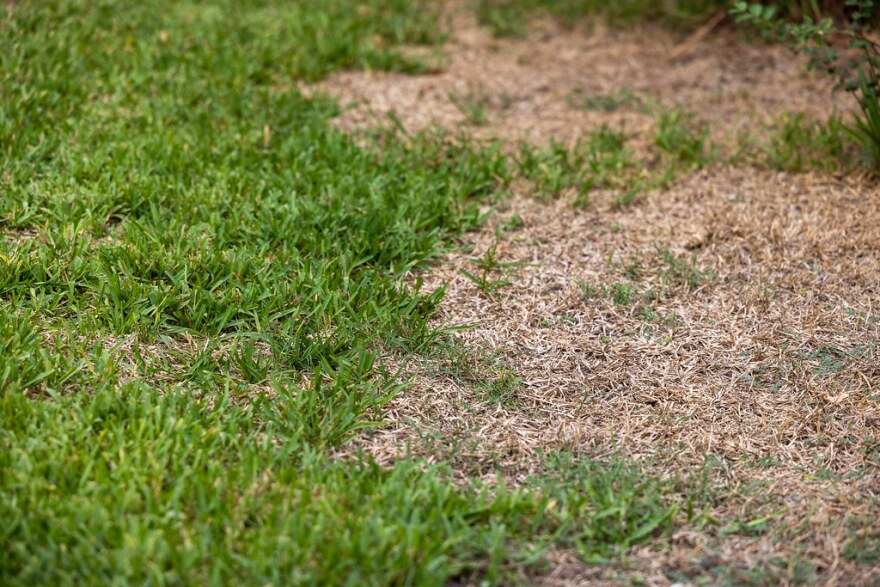
Accept dormancy in severe restriction stages. Bermuda and Zoysia have the biological capacity to enter protective dormancy during extended moisture deficit — the brown appearance is distressing but is not permanent damage in most conditions. A lawn that goes dormant under Stage 3 restrictions and then receives adequate moisture when restrictions ease will typically recover within two to three weeks. Attempting to keep dormant grass green by exceeding the restriction allowance causes more problems (HOA fines, community friction) than accepting the temporary dormancy.
How 2025 Legislation Affects North Texas Homeowners
In 2025, the Texas Legislature passed HB 517 and related measures that restrict HOAs from fining homeowners for brown, drought-stressed lawns or discolored vegetation during municipal water restrictions. This provides important protection for homeowners who follow their municipality's restriction schedules — the compliant homeowner who allows dormancy during Stage 3 restrictions cannot be penalized by HOA enforcement for the resulting lawn appearance.
Understanding this protection changes the calculus for homeowners who felt compelled to exceed water restriction allowances to maintain HOA compliance. Following the restriction schedule and accepting temporary dormancy is now legally protected from HOA penalty in Texas.
Lone Star Mow Co and Water Restriction Periods
Lone Star Mow Co adjusts our service recommendations and maintenance protocols during active water restriction periods in the communities we serve. We communicate restriction-specific guidance to clients when new restriction stages are implemented, adjust mowing height recommendations for restriction conditions, and support the irrigation management decisions that produce the best outcomes within the specific restriction parameters of each client's municipality.

Need guidance on managing your North Texas lawn through water restrictions?
Lone Star Mow Co provides the professional advice and service adjustments that produce the best outcomes under any restriction condition. Serving Keller, Southlake, Haslet, Saginaw, Roanoke, and Trophy Club. Schedule your consultation today.

Ready to Transform Your property?

Find Us On


