

Verticutting vs. Aeration in North Texas: What Each Does and When You Need Which
Verticutting vs. Aeration in North Texas: What Each Does and When You Need Which
North Texas homeowners who research soil improvement services for warm-season lawns encounter two terms regularly: core aeration and verticutting (also called vertical mowing or dethatching). Both are performed with specialized equipment. Both are recommended for Bermuda lawns in this climate. And both are sometimes presented as serving similar purposes — leaving homeowners uncertain about whether they need one, the other, or both.
They are not the same service. They work through different mechanisms, address different lawn problems, and are appropriate at different times and in different circumstances. Understanding the distinction helps homeowners make informed decisions rather than purchasing services that may not address what their specific lawn actually needs.
What Core Aeration Does
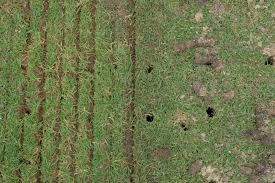
Core aeration uses hollow tines that physically pull cylindrical plugs of soil — typically three to four inches deep and three-quarters to one inch in diameter — from the lawn surface. These plugs are left on the lawn surface to break down and reincorporate. The channels created by the removed plugs remain open for weeks, providing:
Compaction relief in the specific channels where soil has been removed. Improved water infiltration and oxygen access through those channels. Pathways for topdressing material to reach the soil profile rather than sitting on the surface. Introduction of soil microorganisms from the plugs to the thatch layer when the plugs break down.
Core aeration addresses soil compaction and facilitates the organic matter addition that topdressing provides. It does not significantly address thatch accumulation — the hollow tines remove soil without substantially disrupting the thatch layer.
What Verticutting Does
Verticutting uses vertically spinning blades that cut downward through the turf surface — slicing through the thatch layer, cutting horizontally-growing stolons, and lifting organic material to the surface where it can be removed. The equipment looks different from a core aerator: rather than hollow tines pulling plugs upward, verticut blades spin on a horizontal axis and slice downward into the turf.
Verticutting addresses the thatch layer directly — the physical cutting and disruption of thatch material is the primary mechanism, and the material brought to the surface during verticutting is raked and removed from the lawn rather than left to reincorporate.
Verticutting does not address soil compaction in the same way as core aeration. The blades cut through the thatch and into the surface soil, but they do not remove soil plugs that leave channels for compaction relief. The primary benefit of verticutting is thatch reduction through physical disruption and removal.
When Each Is Appropriate
Core aeration is the standard annual service for most North Texas Bermuda, St. Augustine, and Zoysia lawns — appropriate for essentially all properties in this climate on an annual basis because of the compaction that North Texas clay soil and regular use traffic produces. The question for core aeration is not whether to do it but when (spring or fall) and how often (annually for most properties, twice annually for high-traffic or heavily compacted properties).
Verticutting is a corrective service for lawns where thatch accumulation has exceeded the level that annual aeration can manage over a reasonable timeline. When the thatch layer assessment described in the thatch blog reveals accumulation above three-quarters to one inch, and when multiple seasons of annual aeration have not adequately reduced the thatch depth, verticutting as a one-time corrective intervention removes the accumulated material more aggressively than aeration alone can accomplish.
Verticutting is also appropriate as a spring renovation service for Bermuda lawns where the goal is to open the canopy, remove the previous season's dead material at a more thorough level than spring scalping, and stimulate new growth at the beginning of the growing season. Applied to actively growing Bermuda in late spring, verticutting produces a dramatic short-term disruption — the lawn looks severely stressed immediately after the service — followed by vigorous, dense new growth as the Bermuda fills in the open surface.
The timing restriction on verticutting is important: this service should only be performed on Bermuda during the active growing season — April through August in North Texas — when the grass has the growth energy to recover from the stress of vertical mowing. Verticutting during dormancy or at the edges of the growing season when recovery capacity is limited can cause permanent turf damage rather than the beneficial renovation response.
What Most North Texas Lawns Actually Need
For the majority of North Texas residential Bermuda, St. Augustine, and Zoysia lawns receiving regular professional maintenance: annual core aeration and topdressing is the correct ongoing service that addresses compaction, builds organic matter, and progressively manages thatch accumulation. Verticutting is a periodically useful corrective tool for specific properties where thatch accumulation has reached the level that requires more aggressive physical removal.
The lawn that receives consistent annual core aeration starting from establishment typically does not develop the extreme thatch accumulation that makes verticutting necessary — the annual aeration disrupts and manages thatch progressively. The lawn that has not received annual aeration and has accumulated several years of untreated thatch may benefit from verticutting as a reset before the annual aeration program begins.
Lone Star Mow Co provides core aeration as the standard annual service included in complete maintenance programs, and verticutting as a corrective option for properties where the initial assessment confirms significant thatch accumulation that warrants the more aggressive intervention.

Not sure whether your North Texas lawn needs core aeration, verticutting, or both?
Lone Star Mow Co assesses the specific conditions of each property and recommends the correct service. Serving Keller, Southlake, Haslet, Saginaw, Roanoke, and Trophy Club. Schedule your free consultation today.

Ready to Transform Your property?

Find Us On


