


What Brown Patch Fungus Actually Is and How North Texas Lawns Get It
What Brown Patch Fungus Actually Is and How North Texas Lawns Get It
If you have grown St. Augustine grass in North Texas for more than two or three seasons, you have almost certainly encountered brown patch — the most common fungal disease affecting warm-season turf in this climate. The characteristic circular or semi-circular pattern of yellowing, browning, and dying grass that appears overnight or over several days during periods of warm nights and wet conditions is one of the most recognizable and most frustrating lawn problems in the region.
What homeowners often do not understand is why their lawn gets brown patch when the neighbor's lawn does not, what conditions specifically create the disease environment, and — most importantly — what the correct management response is versus the common approaches that do not work or that make the problem worse.
What Brown Patch Fungus Is
Brown patch is caused by Rhizoctonia solani, a soil-borne fungal pathogen that infects grass crowns, sheaths, and roots under specific environmental conditions. It is present in the soil of virtually every North Texas lawn — it does not have to "arrive" from an outside source. The pathogen exists in dormant form and becomes active when the combination of high temperature, high humidity, and moisture on the grass surface creates the conditions it requires to reproduce and infect.
The specific environmental conditions that trigger brown patch activation in North Texas are:
Night temperatures consistently above 70 degrees Fahrenheit combined with daytime temperatures above 90 degrees. This temperature profile is present from roughly May through September in most North Texas years.
High humidity or extended moisture on the grass blades — specifically from evening or overnight irrigation, heavy dew, or rainfall that leaves the grass surface wet for extended periods.
When both conditions are met simultaneously — high temperatures and extended leaf wetness — brown patch fungus activates rapidly. Lesions develop on individual grass blades, the fungal network spreads through the thatch layer and soil, and the visible circular to semi-circular brown patterns appear on the lawn surface within one to several days of the initial infection.
Why Some Lawns Get Brown Patch and Others Do Not
The same temperature and humidity conditions exist across an entire neighborhood during a brown patch event — but not every lawn on the street develops the disease. The difference is in the specific conditions on individual properties that either favor or discourage fungal activity.
Evening and overnight irrigation is the most direct controllable risk factor for brown patch. Lawns irrigated in the late afternoon or evening hours have moisture on the grass blade surface through the warm nighttime period — the precise combination of warm temperatures and extended leaf wetness that brown patch requires. Lawns irrigated only in the early morning hours — before 10 AM — have grass blades that dry completely through the day, eliminating the extended leaf wetness condition that fungal infection requires.
This single irrigation timing factor explains a significant portion of the variation in brown patch incidence between otherwise similar properties. Two lawns with identical grass type, identical density, and identical soil conditions but different irrigation timing will frequently show dramatically different brown patch incidence. The morning-irrigated lawn rarely develops significant brown patch. The evening-irrigated lawn may develop it every warm, humid season.
Excessive nitrogen fertilization in summer is the second major risk factor. High-nitrogen fertilization in summer pushes rapid new shoot growth — and the tender, rapidly produced new tissue is more susceptible to Rhizoctonia infection than slowly-grown, mature grass tissue. Professional fertilization programs that avoid high-nitrogen applications during the peak brown patch period (July through September) consistently show lower brown patch incidence than programs that continue aggressive nitrogen application through summer.
Thatch accumulation creates the warm, moist, low-oxygen environment in the turf profile that favors Rhizoctonia persistence between growing seasons. Lawns with significant thatch show higher brown patch incidence than lawns with managed thatch thickness — both because the thatch layer provides habitat for the pathogen and because it creates the moisture retention conditions at the grass surface that extend the leaf wetness period after irrigation or rainfall.
Shade and poor air circulation extend the leaf wetness period by limiting the evaporation that removes moisture from the grass surface after irrigation or dew events. Areas of the lawn under dense tree canopy or adjacent to fence lines and structures that limit air movement show disproportionately higher brown patch incidence than open, well-ventilated areas of the same property.
What Brown Patch Damage Actually Looks Like
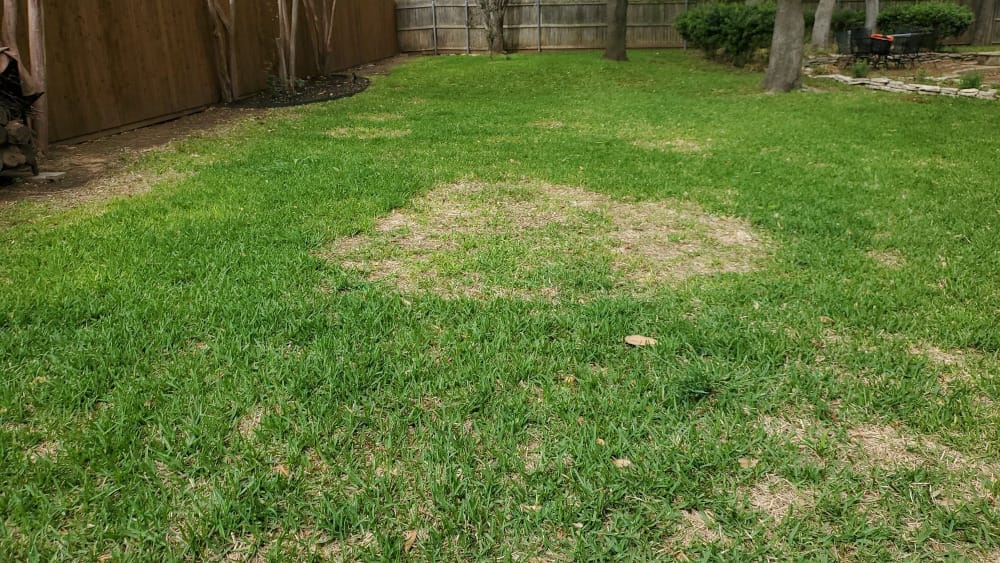
The characteristic brown patch pattern is circular to semi-circular patches of yellowing or browning grass that can range from a few inches to several feet in diameter. In severe outbreaks, multiple patches may coalesce into larger affected areas.
The diagnostic detail that distinguishes brown patch from drought stress and other common lawn problems is the "smoke ring" — a darker, water-soaked or grayish border at the outer edge of the affected patch that is visible in early morning before the dew has dried. This smoke ring represents the active advancing edge of the fungal infection. Not all brown patch outbreaks produce a visible smoke ring, but when present it is a reliable diagnostic indicator.
Individual grass blades affected by brown patch show irregular tan to brown lesions with darker brown borders — the lesion pattern on individual blades is distinct from the uniform yellowing of iron chlorosis or the tip dieback of drought stress.
The important distinction: Brown patch affects the grass blades and crowns but typically does not kill the underground rhizome and stolon network in established Bermuda or St. Augustine. Affected areas, once the fungal activity is controlled and conditions improve, typically recover through regrowth from the surviving underground plant material — a timeline of two to four weeks under correct post-disease management.
What Actually Works to Manage Brown Patch
Irrigation timing correction is the highest-impact management action available and the one that costs nothing. Moving irrigation to morning-only timing — strictly before 10 AM — eliminates the extended nighttime leaf wetness that creates the primary condition for brown patch activation. On properties where evening irrigation is the current practice, this single change consistently reduces brown patch incidence in subsequent seasons more than any fungicide application.
Fungicide application is appropriate when active infection has been confirmed and when the environmental conditions that support disease activity are expected to continue. Azoxystrobin, propiconazole, and thiophanate-methyl are among the fungicide active ingredients with documented efficacy against Rhizoctonia solani. Application timing matters — fungicide applied at the first signs of disease activity (the smoke ring stage) is more effective than application after significant tissue loss has occurred. Preventive applications during high-risk periods (warm, humid summer weather) are appropriate on properties with a history of severe annual brown patch.
Avoid nitrogen fertilization during active infection. High nitrogen during an active brown patch outbreak stimulates the susceptible new growth that the pathogen preferentially infects. Defer fertilization until the outbreak is controlled and the environmental conditions that triggered it have passed.
Address thatch through annual aeration. The long-term brown patch management benefit of annual core aeration — reducing thatch accumulation and improving the soil biology that competes with pathogen persistence — is one of the preventive dimensions of the soil health program described throughout this blog series.
Lone Star Mow Co's professional property monitoring during the warm season includes active attention to brown patch risk and early outbreak identification. Early identification and correct management response — irrigation timing guidance, appropriate fungicide application timing where warranted — limits disease impact significantly compared to the outcomes from late identification and incorrect management.

Dealing with recurring brown patch on your North Texas lawn? Let Lone Star Mow Co identify the cause and manage it correctly.
Serving Keller, Southlake, Haslet, Saginaw, Roanoke, and Trophy Club. Schedule your free consultation today.

Ready to Transform Your property?

Find Us On


