


What Happens to Landscape Plants During Extreme Heat Events in North Texas
What Happens to Landscape Plants During Extreme Heat Events in North Texas
The most demanding environmental stress that North Texas landscape plants experience is not drought, though drought is a significant challenge. It is not freeze damage, though hard freezes are genuinely damaging. The most consistently severe stress is the extended high-temperature periods — weeks of days above 100 degrees Fahrenheit — that are a regular feature of July and August in this climate.
These extreme heat events affect different plants in different ways. Some species that are well-adapted to North Texas conditions handle sustained triple-digit temperatures with minimal visible distress. Others show clear stress symptoms that, if misidentified or mismanaged, develop into permanent damage. And some species — those selected without full consideration of this climate's heat demands — simply fail during the first significant heat event they experience after installation.
Understanding what heat stress looks like in landscape plants, which plants are most vulnerable, and what the correct management response is during and after extreme heat periods is part of the professional landscape knowledge that Lone Star Mow Co brings to the properties we serve.
How Plants Respond to Extreme Heat
Plants regulate their temperature through transpiration — the evaporation of water from leaf surfaces that cools the plant tissue the way sweating cools a human body. This process works reasonably well at moderate temperatures with adequate soil moisture. Under sustained temperatures above 100 degrees with low humidity and full sun exposure, the demands of transpiration exceed what most plants can meet — and various stress responses begin.
Wilting is the most visible heat stress indicator in most landscape plants. When the rate of water loss through transpiration exceeds the rate at which roots can deliver water from the soil, the internal water pressure (turgor pressure) that keeps plant cells rigid declines, and the plant's leaves and stems lose their firm posture. Wilting appears first in the newest, most actively transpiring growth and progresses to older foliage as stress intensifies.
Temporary wilting during the hottest afternoon hours that recovers overnight is normal in many plants during extreme heat periods — this is the plant doing its best to manage the thermal environment it cannot avoid. Wilting that does not recover overnight indicates a more severe moisture stress that needs attention.
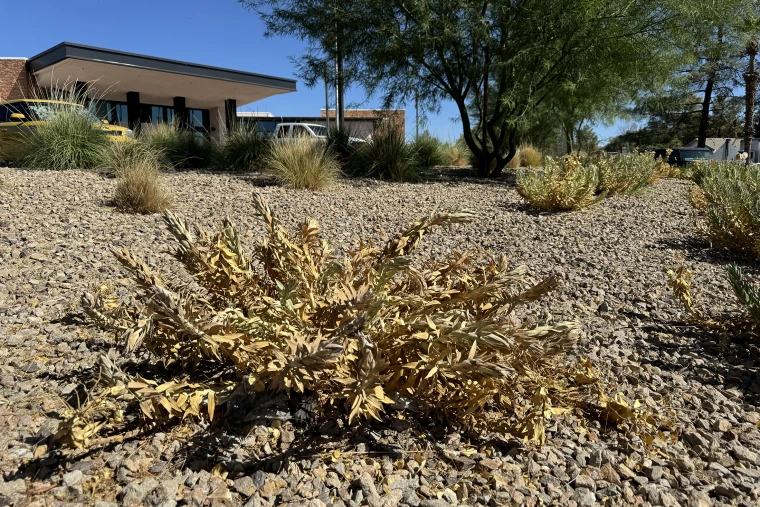
Leaf scorch — the browning and crisping of leaf margins and tips — is a specific heat and moisture stress response that many North Texas landscape plants show during extreme heat events. The leaf edges are the most exposed, most transpiring portions of the leaf, and they are the first to suffer cellular damage when the transpiration demand exceeds the plant's ability to maintain tissue hydration. Mild leaf scorch on otherwise healthy plants during a heat wave is not the same as a pest or disease problem — it is a direct heat response. Plants that show scorch should recover when temperatures moderate and adequate soil moisture is maintained.
Premature leaf drop is a stress response that some deciduous plants use to reduce their transpiration surface area during extreme heat. A plant dropping a portion of its leaves during a heat event is not necessarily dying — it is managing the stress by reducing the total leaf surface that needs to be kept hydrated. This response is most common in plants that are marginally adapted to North Texas heat conditions.
Plants That Handle Extreme Heat Well
The North Texas plant palette includes a meaningful number of species that handle extreme heat with genuine composure — species that can be observed during the worst August heat waves showing no significant stress symptoms in well-established, appropriately watered installations.
Chinese Pistache shows minimal heat stress symptoms in established plantings, even during extended periods above 100 degrees. Its deep root system, developed over multiple growing seasons, accesses soil moisture reserves well below the surface zone that dries out most rapidly during heat events.
Texas Sage (Cenizo) is arguably the most heat-tolerant ornamental shrub available for North Texas landscape beds. It evolved in conditions even hotter and drier than this climate's worst periods, and it handles extended triple-digit temperatures without visible stress as long as it is not being over-watered (which is actually more damaging to Texas Sage than under-watering during heat events).
Yaupon Holly — both standard and dwarf forms — handles extreme heat well in established plantings. Its native adaptation to the Texas Hill Country and eastern Texas coastal regions includes exposure to significant heat events that have conditioned the species for this climate's demands.
Lantana and Knockout Roses both perform at or near their best during North Texas heat events — both are summer-blooming species that evolved for hot conditions, and their peak performance coincides with the periods that stress most other plants.
Plants That Show Significant Heat Stress in This Climate
Japanese Maples are the most consistently heat-stressed ornamental trees in North Texas residential landscapes. They are spring garden favorites — the lace-leaf and coral bark varieties are genuinely beautiful — but they are fundamentally cool-climate plants. In full sun during a North Texas August heat wave, Japanese Maple foliage scorches, crisps, and often falls prematurely. This is not an installation failure or a disease — it is the plant's response to conditions it was never evolutionarily equipped for. Japanese Maples succeed in this climate only in sheltered, heavily shaded locations that protect them from afternoon sun and moderate the air temperature around them — a demanding siting requirement that most residential landscape positions do not meet.
Gardenias are similarly marginal in this climate's heat conditions. They bloom beautifully in late spring, but during July and August in full sun they consistently show leaf scorch, bud drop, and general decline that requires significant recovery effort in fall. Gardenias can succeed in this climate in east-facing or heavily shaded locations that protect them from afternoon sun — but they are a high-maintenance, heat-sensitive choice compared to the adapted alternatives.
Azaleas — most varieties — are stressed by extended exposure to conditions above 90 degrees Fahrenheit. North Texas's sustained heat events push well beyond this threshold. Azaleas can succeed here in deeply shaded locations with moist, well-drained, acidic soil — conditions that are rare on most residential properties. Azaleas selected without full understanding of these requirements consistently disappoint in North Texas landscapes.
The Correct Response During an Extreme Heat Event
Do not panic-water. The intuitive response to wilting landscape plants is to water more. The correct response depends on what is actually happening in the soil. If the soil is adequately moist at the root zone depth — confirmed by the screwdriver test described earlier — additional watering will not help and may harm by creating the saturation conditions that reduce oxygen availability to roots. The plant may be wilting despite adequate soil moisture because the heat-driven transpiration demand exceeds what even an optimally irrigated root system can meet in the hottest afternoon hours.
Confirm soil moisture before supplemental irrigation. The screwdriver test or a soil probe check at the root zone depth indicates whether the plant's stress response is from genuine soil moisture deficit or from heat demand that exceeds the plant's capacity regardless of soil moisture. If soil moisture is adequate at root depth, the correct response is to wait — the plant should recover overnight as temperatures drop. If soil moisture is genuinely depleted to the root zone depth, supplemental irrigation is appropriate.
Do not prune heat-stressed plants during the heat event. Removing heat-damaged tissue during the stress period exposes new wound surfaces at a time when the plant's resources for wound response are already fully committed to managing the thermal stress. Wait until temperatures moderate and assess the damage then — some tissue that appears dead during extreme heat events recovers when conditions normalize.
Protect newly installed plants specifically. Plants installed in the weeks before or during an extreme heat event are most vulnerable because their root systems have not yet developed the depth and contact with the soil profile that established plants have. New installations during or immediately before heat events warrant specific additional irrigation attention — daily watering rather than the deep infrequent approach appropriate for established plants.
How Lone Star Mow Co Supports Clients Through Heat Events
Professional lawn and landscape maintenance through extreme heat periods includes the monitoring and communication that allows clients to make informed management decisions. When maintenance visits during a heat event reveal significant plant stress, clients hear about it proactively — not at the next service visit but during or immediately after the visit where it is observed.
Our landscape installations use plant species proven for North Texas heat conditions specifically — the selection process that prevents the heat stress failures described above from being built into a new installation in the first place. When we observe heat stress on species in existing landscapes, we provide honest assessments of whether the plant will recover and perform adequately in subsequent seasons or whether replacement with a better-adapted species is the more practical path.

Concerned about how extreme heat is affecting your landscape plants? Let Lone Star Mow Co assess what's happening and advise on the right response.
Serving Keller, Southlake, Haslet, Saginaw, Roanoke, and Trophy Club. Schedule your free consultation today.

Ready to Transform Your property?

Find Us On


